
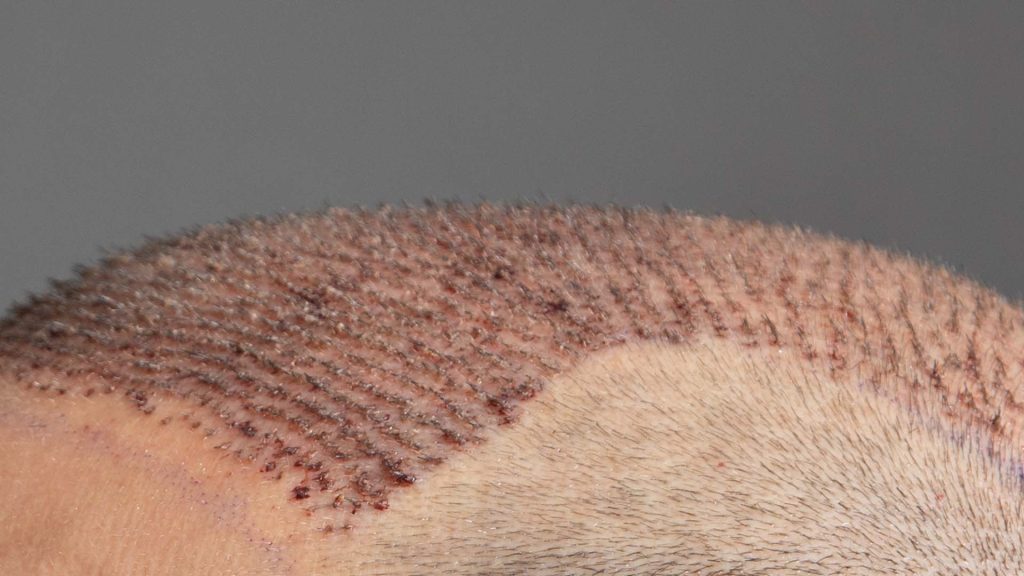
The hair transplant graft survival rate is the degree to which transplanted hair follicles stay alive in their new area and keep producing hair, and it depends not on a single factor but on a combination of several. Chief among them are the condition of the donor area, the planning and execution of the procedure, aftercare and the person’s own hair structure. It would not be right to give a single figure that applies to everyone; the result is determined by the doctor’s personal evaluation.
Short answer: what the survival rate means
The survival rate is a measure of how many of the transplanted follicles continue to live in their new place and produce hair. The result usually becomes clear in the months after the transplant, as the hairs grow; the shedding seen in the first weeks (shock loss) is a natural part of the process and does not mean the hair has not taken.
This rate varies from person to person. So instead of focusing on a percentage figure, it is more useful to understand the conditions that affect that figure.
Factors that affect survival
The main factors that affect survival are the quality of the donor area, how the follicles are harvested and placed, the condition of the scalp, general health and aftercare.
- Hair density and follicle structure in the donor area
- The health of the scalp and its blood circulation
- The medications the person uses, habits such as smoking, and general health
- How long the follicles stay outside the body and the care taken during the procedure
- Application details such as the angle, depth and direction of implantation
- Following the recommendations after the procedure
Some of these depend on the person and some on the application. At the preliminary evaluation, the doctor sees the personal conditions and draws a realistic expectation.
The donor area and the procedure technique
The donor area is the healthy hair area at the back and sides of the head that is used for the transplant; the quality of this area forms the basis of survival.
The hair in this area is genetically more resistant to shedding. This is called donor dominance, and it is the reason the transplanted follicles largely keep this feature in their new places. For this reason, the density and health of the donor area also determine the amount of transplantation that can be planned.
On the technique side, methods such as FUE and DHI are used. Which one suits you is determined by the width of the thinning area, the condition of the donor area and your expectation. You can review our methods on our Izmir hair transplant page.
The role of aftercare
Aftercare directly affects survival because it protects the newly transplanted follicles during the settling period.
Not touching the transplant area in the first days and following the doctor’s recommendations, such as those on washing and sleeping routine, protects the follicles. In the case of itching or scabbing, it is also important to wait for the check-up process instead of intervening. Since habits such as smoking and alcohol can negatively affect healing, the recommendations about them should also be taken seriously.
Results in women
Hair transplantation in women can provide a natural appearance when a suitable candidate is selected; however, since hair loss in women is often widespread and diffuse, the evaluation is made more carefully.
Compared with the distinct bald areas common in men, thinning in women may spread over a wider area. In this case, whether the donor area is sufficient and resistant, and the cause of the hair loss and whether it is continuing, are investigated first. For details you can look at our article who is hair transplantation suitable for in women.
Evaluation at 50 and over
Age itself is not an obstacle to hair transplantation on its own; at 50 and over, what is decisive is the condition of the donor area, general health and expectations.
At this age the hair strands may have thinned and the density of the donor area may be different from that of younger people. The medications used and accompanying diseases are also part of the evaluation. If there is a healthy donor area and a realistic expectation, a transplant can make sense. The decision should be made together with the doctor at the examination.
Permanence of transplanted hair
Thanks to donor dominance, transplanted hair generally stays for many years; however, the person’s own hair continuing to thin with age can affect the appearance over time.
If the existing, non-transplanted hair continues to shed, the area around the transplanted region may thin and look like an island; this is called the island effect. To reduce this, it is important to make a forward-looking plan at the beginning and, if necessary, to plan supportive treatments. For more about duration, take a look at the article how many years does a hair transplant last.
Frequently asked questions
What is the hair transplant graft survival rate?
It is the degree to which transplanted follicles continue to live in the new area and keep producing hair. It varies from person to person according to the donor area, the application and aftercare.
What are hair transplant results like in women?
When a suitable candidate is selected, a natural appearance can be achieved. However, because hair loss is often widespread, the cause and the donor area need to be evaluated first.
Does it make sense to have a hair transplant at 50?
It can make sense if the donor area is sufficient, general health is suitable and expectations are realistic. Age alone is not decisive; a doctor’s examination is needed.
Does transplanted hair stay for life?
Transplanted hair generally stays for many years because of donor dominance. Still, since the person’s own hair may continue to thin with age, it would not be right to give a definite period for permanence.
Does a hair transplant become outdated?
Transplanted hair does not become outdated, because it carries the resistant nature of the donor area. However, if the surrounding existing hair continues to shed, the island effect may be seen; this can be reduced with advance planning.
Next step
To find out what will affect survival in your own case, you can have an examination at Özel Demiderm Polikliniği. The doctor evaluates your donor area and your expectations together. For an appointment, you can use the make an appointment page.