
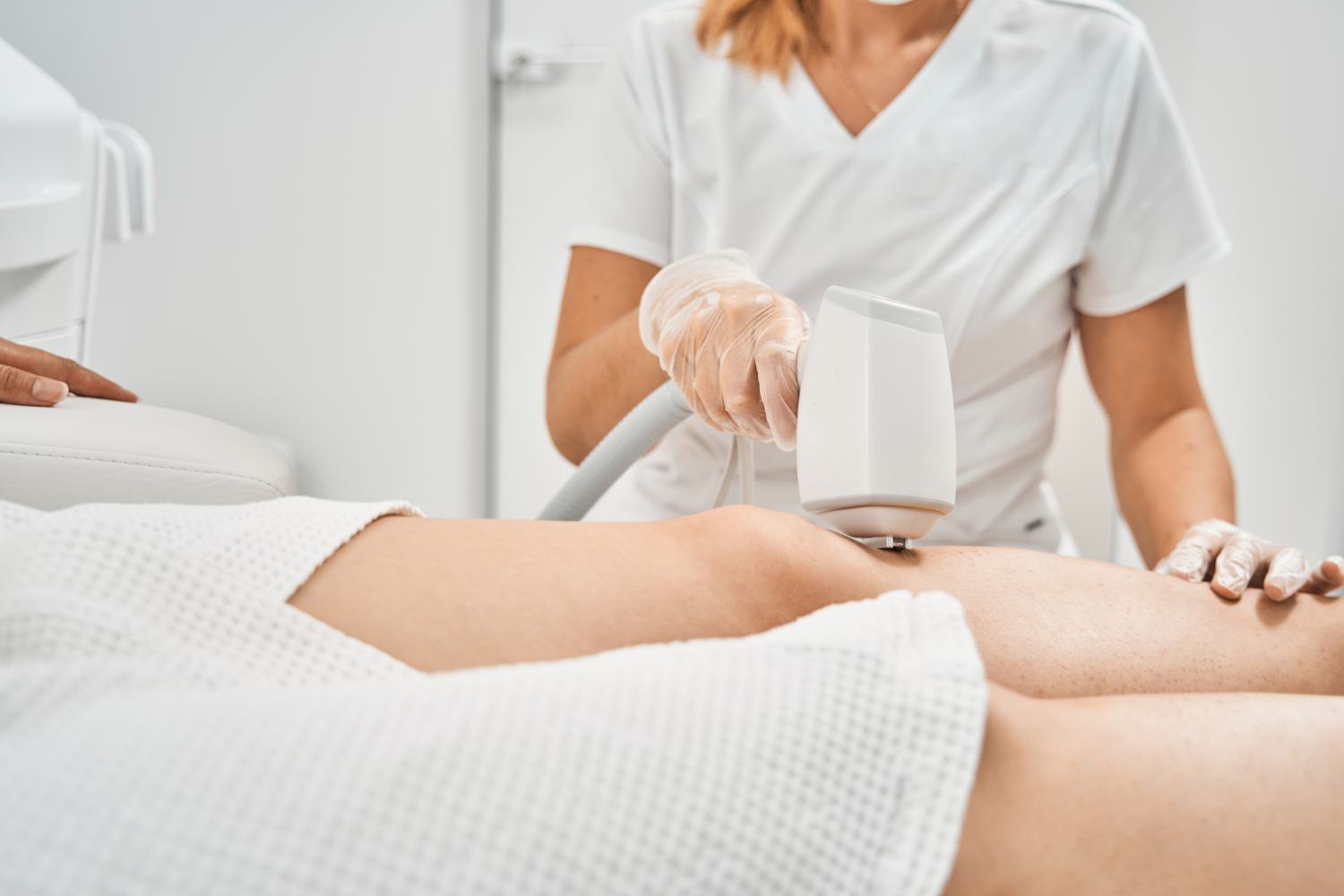
Professional ND:YAG laser hair removal treatment is an advanced medical technology-oriented aesthetic service based on the principle of destroying the deep vascular feeding vessel networks and the germinal cell bed that directly nourish the hair root through photo-thermal selectivity, with infrared radiation beams at a wavelength of 1064 nm completely bypassing epidermal melanin pigment, in order to permanently claim away and eliminate unwanted hair follicles, offering the highest safety profile especially in dark skin types and deeply situated coarse hairs.
What is ND:YAG Laser Hair Removal?
ND:YAG laser hair removal (Neodymium-doped Yttrium Aluminum Garnet), registered as a long-wavelength photo-thermolysis system in medical aesthetic and dermatological literature, is a non-micro-invasive permanent hair removal discipline aimed at bringing hair follicles into a completely non-functional phase. Unlike classic hair removal devices, this technology does not deliver its energy to the melanin (color) pigments in the upper layer of the skin. Thanks to its 1064 nm infrared spectrum dimension, the ND:YAG system completely bypasses the epidermis and exhibits the strength to progress along a linear line down to the reticular dermis, which is the deepest bed of the skin. This process is a biological and physical therapeutic model that eliminates the primary micro-structures holding the hair root’s axis of life, rather than temporarily clearing the surface like externally applied chemical depilatories.
- Deep Dermal Progress: The power of the beams to lock onto hair oxy-hemoglobin molecules at a depth of 4-5 mm in the skin, destroying even the deepest roots.
- Epidermal Epidermis Protection: Minimizing the risks of burns and skin discoloration (hypopigmentation) due to not displaying color selectivity in the upper skin.
- Bio-Mechanical Longevity: The biology of seamlessly sealing the feeding units of hair factories in the anagen (growth) phase via photo-thermal heat.
How is ND:YAG Laser Hair Removal Applied?
The ND:YAG laser procedure performed in the clinic room is a highly precise photo-thermal workflow carried out with full outpatient comfort, which completely eliminates the capillary vessel breakage and permanent spot risks that analog salon methods can bring. The process begins with washing the anatomical quadrants planned for hair removal with surgical antiseptics and bringing the hair lengths to a level of 1 mm in accordance with the procedure calibration. During the procedure, gaseous or integrated air cooling units (cryotherapy cryogen systems) that protect the skin during shooting are shifted into the active phase. The laser handpiece is brought to a fully perpendicular angle relative to the skin surface, scanning all hair beds in a leakproof manner via circular scanning movements with light bursts lasting milliseconds.
- Dynamic Gas Cooling: Preventing the upper skin from feeling pain by spraying -20°C gas onto the skin exactly one millisecond before each laser shot.
- Square Pulse Technology: The phase step of delivering energy to the tissue in homogeneous and linear strips instead of waves, zeroing out burn risks.
- Atraumatic Scanning Order: Delicately claiming away the areas in a milimetric caliper order without overlapping (without performing a double pass).
Who is ND:YAG Laser Hair Removal Suitable For?
Infrared laser hair removal courses are medically suitable for all adult individuals who present with confirmed unwanted hair problems, or whose skin smoothness is diminished due to ingrown hair or ingrown hair anomalies (pseudofolliculitis). Since the procedure does not irritate the color cells (melanocytes) in the upper skin, it weaves a complete bio-safety shield even for sensitive individuals possessing dark, tanned, or black skin types. However, for cases whose medical history indicates active epilepsy (seizure) attacks, those harboring weeping eczema, psoriasis, or pyogenic infection foci in the area to be injected or shot, or individuals with ongoing heavy medication use creating photosensitivity (isotretinoin-like), this elective process is not medically suitable.
- Those Possessing Dark and Tanned Skin Biotypes: Individuals having Type IV, V, and VI skin color according to the Fitzpatrick Scale, who fear burning with other lasers.
- Those Experiencing Chronic Ingrown Hair and Folliculitis Problems: Patients whose leg and groin lines present with insidious cystic ingrown wounds due to razor or waxing neglect.
- Men Possessing Coarse and Deep Root Structures: Male clients whose hair roots display an excessively deep situation in the back, shoulder, and upper beard cheek corridors.
In Which Situations Can ND:YAG Laser Hair Removal Be Preferred?
Preferring long-wavelength ND:YAG laser technology over alexandrite or diode systems is indicated as a definitive medical rule in situations where hair roots display an excessively deep situation, the skin color is dark, or ingrown hair complications disrupt mucosal integrity. When the skin darkens, other short-wavelength devices mistake the skin for a hair root and explode energy on the surface; this is contrary to the principles of preventive medicine. The expert physician definitively decides on this evidence-based rational workflow when wishing to protect the patient from permanent spots and directly sever the oxy-hemoglobin connection nourishing the hair follicle.
| Skin Phototype / Hair and Ingrown Hair Pathology Class | Medical Preference Criterion and Clinical Reason | Expected Ultimate Cellular Success Output from the Application |
|---|---|---|
| Fitzpatrick Type V-VI (Very Dark / Tanned Skin) | The presence of a high melanin density in the upper skin running the risk of producing laser burns. | Complete protection of the epidermis, verifying spot-free smooth hair removal success. |
| Hirsutizm / Hormonal Excessive Hair Growth | The risk of fine hairs in the chin and facial segment being triggered and turning coarse (paradoxical effect). | Lowering hair volume by targeting merely the coarse roots, without inciting fine hairs. |
| Chronic Pseudofolliculitis (Leg / Groin Ingrowns) | Hairs curling beneath the skin to weave inflammatory cysts and insidious spot towers. | Linearly claiming away the root, resulting in ingrowns deflating within seconds and tightening pores. |
| Deeply Situated Masculine Hair Roots (Male Back) | The situation of hair follicle bulbus centers hiding 4 mm beneath the skin. | The phase where the 1064 n m wavelength reaches the deepest root to create permanent calcification loss. |
How is Skin and Hair Analysis Performed Before ND:YAG Laser Hair Removal?
The clinical analysis phase performed before the radiation and dose calibration schedule is finalized is the most vital pre-operative check-up stage that extracts the skin’s lipid stability and hair shaft thickness index scores with mathematical clarity. At this stage, the specialist magnifies whether the hair roots cluster in the anagen, catagen, or telogen phases with the help of dermo-scanner and trichoscope cameras. During the analysis, hair density per cm², the micron diameter of the hair shaft, and the skin’s Fitzpatrick color phototype class score are scanned layer by layer and recorded on the patient’s digital card; laser millisecond (ms) and joule ($J/cm^2$) energy parameters are calibrated by software based on these data.
- Dermatomic Color Scale Measurement: Determining the undertone variations of the skin color based on winter or summer exposure.
- Hair Root Depth Probing: The process of verifying the vertical subcutaneous growth axis of the hair body and the bulbus location.
- Barrier Moisture Balance Analysis: Measuring dryness levels in the stratum corneum layer of the skin to eliminate post-procedure sensitivity risks.
In Which Skin Types Can ND:YAG Laser Hair Removal Be Applied?
The greatest luxury that biomedical technology has introduced to hair removal avenues is that the ND:YAG laser spectrum can be applied with complete safety and confidence across all skin types registered from Type I to Type VI in medical literature according to the Fitzpatrick Scale (from the fairest skins to the darkest African skin types, and even intensely tanned skins fresh out of active sunbathing). While dark skins are accepted as a contraindication (obstacle) in short-wavelength systems, thanks to this autologous vascular-targeted system, skin color cannot place a mechanical set on the hair removal workflow; the process is operated stably across every season.
How Does ND:YAG Laser Technology Work?
The physics of radiation units destroying hair roots depends on the laws of “selective photolysis” and “vascular coagulation.” Phatons at a wavelength of 1064 nm released from the ND:YAG laser crystal select the oxy-hemoglobin substance inside the capillary vessels nourishing the hair root as their primary target when they strike the skin, instead of the hair’s melanin pigment. The light energy is transformed within seconds into a high photo-thermal heat energy within this vessel bed; intravascular blood proteins clot (coagulate), cutting off the hair root’s food axis along a linear line. The hair factory whose nutrition is completely stopped transitions into a phase incapable of cellular synthesis, and the shedding phase begins with stability.
In Which Body Regions Can ND:YAG Laser Hair Removal Be Applied?
Adhesive and regenerative laser shot stations can be successfully applied to all delicate mucosal and skin frame quadrants in human anatomy where hair follicle proliferation is verified and aesthetic or hygienic purification is aimed. The primary regions where the process is actively applied are as follows:
- Facial Areas (Face): Upper lip (mustache), chin, temples, and along cheek upper cheekbone corridors in men,
- Wide Body Quadrants: Back, shoulders, chest cage in men; smoothing out entire legs and arms in women,
- Delicate Mucosal Borders: Safely without causing damage to lymphatic channels along the armpit (axilla) and inguinal groin (bikini) lines,
- Ingrown Hair Foci: Prophylactic sealing of insidious hair cysts in the sacrococcigeal (tailbone) region.
What Are the Differences Between ND:YAG Laser Hair Removal and Other Laser Hair Removal Methods?
The most radical differences between ND:YAG laser shot protocols and Alexandrite (755 nm) or Diode (810 nm) hair removal systems are the intra-tissue emilimation target molecules of the beams, needle-free cooling integration depths, session sittings intervals, and the spot-free safety architecture they exhibit in dark skin types. Since the Alexandrite laser is directly melanin-targeted, it is contraindicated in dark skins; ND:YAG, however, completely absorbs skin color by targeting the vessel. In the comparison table below, the technical parameters of the three major laser hair removal classes in medical standards are listed:
| Technical and Clinical Evaluation Criterion Group | ND:YAG Laser System (Long Wavelength) | Alexandrite Laser System (Short Wavelength) | Diode Laser System (Medium Wavelength) |
|---|---|---|---|
| Laser Beam Nominal Wavelength | 1064 nm (Infrared spectrum) | 755 nm (Visible red light) | 810 nm (Near-infrared line) |
| Primary Target Chromophore Inside Tissue | Oxy-hemoglobin (Vessel red blood cell structure) | Melanin (Hair and skin color pigment) | Melanin and Water (Mixed absorption) |
| Applicability in Dark / Tanned Skins | %100 Safe; works on Type VI skins too. | Forbidden / Risky; causes spots and burns on dark skins. | Partially safe; requires gel isolation. |
| Maximum Progress Depth Inside Tissue | Very deep ($4-5 mm$ dermis bed). | Superficial ($2-3 mm$ sub-epidermis). | Medium ($3-4 mm$ depth corridor). |
| Success on Fine Vellus Hairs | Does not cause triggering; safety limit is high. | Harbors the risk of inciting fine hairs on the face. | Effective on fine hairs via ironing mode phase’i. |
How Many Sessions of ND:YAG Laser Hair Removal are Applied?
The total number of sessions for laser sealing courses requires a specific sitting hierarchy in medical literature, depending on the genetic anagen growth calendar schedules of hair follicles and the patient’s hormonal androgenic stability coefficients. Since the laser can merely seal roots in the active growth phase, the reawakening schedule of sleeping roots in the telogen must be waited for. To close this biological cycle with full leakproofness, scheduling the processes as a holistic course of 6 to 8 sessions in total repeated at 6 to 8-week intervals for body regions, and 4-week intervals for the facial region, is an absolute medical rule.
How Long Does the ND:YAG Laser Hair Removal Procedure Take?
Thanks to the scanning frequency rapidity of modern robotic handpieces, radiation sessions are among the most practical dental and medical processes showing a gratifying adaptation to the heavy time constraints of modern metropolitan life. The duration in the session room is linearly proportional to the width of the quadrants to be shot. While the stages of scanning complex two-leg quadrants take an average of 30-40 minutes; completely claiming away local delicate mucosal lines like the mustache, chin, or armpit is usually smoothly concluded in a microscopic duration of only 5 to 10 minutes per session.
Which Stages Are Performed During ND:YAG Laser Hair Removal Application?
The physical preparation and radiation steps carried out in the treatment chair progress through a strict medical hierarchy that completely eliminates the micro-leakage and burn risks that human error can bring. Each phase contains technical infrastructure chains that will directly reinforce the sealing quality of photons to be injected into capillary vessels in the next stage. A protective eyewear order is executed without compromise throughout the process.
- Phase 1 (Hygiene and Marking): Purifying the application field with non-alcoholic solutions, isolating spots or moles with white protective pencils,
- Phase 2 (Eye Safety): Wearing special protective medical goggles for the patient and specialist to prevent laser beam waves from irritating the retina,
- Phase 3 (Robotic Radiation): Weaving the shot strips by bringing the handpiece into full perpendicular contact with the skin accompanied by cryogen gas cooling,
- Phase 4 (Soothing): The phase of applying zinc oxide-based barrier creams to moisturize the skin and protect pore walls upon completion of radiation.
How Does the Healing Process Progress After ND:YAG Laser Hair Removal?
The post-operative tissue recovery phase progresses in an extremely predictable, rapid, and comfortable manner due to involving scalpel-free and stitch-free steps. The formation of milimetric pink blisters (perifollicular edema) at hair follicle openings and a mild skin warming during the first 24 hours following the procedure, linked to the coagulation of capillary vessels around the hair follicle, is a completely natural physiological cell repair reaction given by the extracellular matrix. Healing speed flows swiftly; blisters deflate in 1 day, and the claimed away lifeless hairs slide and shed smoothly out of pores within a 2-week process.
What Should Be Considered After ND:YAG Laser Hair Removal?
To render the functional success of the sealing session permanent without relapse, support the dissolved vessel bonds to maintain full closure stability, and preserve the sealing quality of fresh pores, there are some strict medical home care rules the patient must observe in the home environment after the procedure. It must absolutely not be forgotten that during the early hours, the skin walls can temporarily transition into a phase more sensitive to external factor leakages.
The medical rules that must be meticulously observed at home during the critical post-procedure period are as follows:
- For the first 24 hours, the procedure area must absolutely not come into contact with water and hot baths should not be taken, in order to prevent bacteria from seeping through irritated pores and triggering infections/folliculitis.
- During the period between laser sessions, root-plucking actions such as tweezers, waxing, epilators, or threading are completely forbidden so as not to disrupt the orientation axis of new roots reawakening from sleep; only superficial shaving can be done.
- To prevent acid accumulation in pores through facial and bodily sweating, sauna, Turkish bath, solarium, and heavy cardio sports activities must be entirely postponed for the first 48 hours.
- For the first 3 days post-session, alcoholic perfumes, deodorants, or acidic sharp peeling chemicals that can irritate the skin must be kept away from the line.
Why is Sun Protection Important After ND:YAG Laser Hair Removal?
Isolating facial and bodily skin without compromise from the sun’s ultraviolet (UV) radiation shield following radiation courses is the most vital safety rule that prevents melanocyte cells from developing a hyperpigmentation (spot) reaction. The skin frame, temporarily sensitized by laser energy, begins to rapidly produce spot pigments to protect itself the exact second it encounters unprotected sunlight. To prevent the weaving of these insidious spot towers, applying verified 50+ factor broad-spectrum medical sunscreen creams 3 times a day, every 4 hours without making a summer or winter distinction is a medical necessity.
How Should Skin Care Be Performed to Prevent Spot Formation?
Post-session home hygiene routines must contain a delicately balanced discipline that will reinforce the gained smooth epithelial quality but will not mechanically distress fresh skin margins. The use of coarse-granular soaps or harsh bath fibers with excessively high abrasives sold in pharmacies is strictly forbidden during the first week post-procedure as they can scratch the face; home hygiene must be entrusted to ceramide-containing soft cleansings.
- Bio-Active Moisture Locking: Applying pure aloe vera or zinc-containing medical moisturizers to the skin every night to protect the moisture chain of the subcutaneous fibroblast bed and extinguish heat sensitivity.
- Soft Sweeping Purification: The rule of gently washing the skin with pH-neutral soft foams using fingertips without scratching during showers performed after the 24th hour.
What Are the Advantages of ND:YAG Laser Hair Removal?
The advantages provided by biomedicine and infrared laser technologies to the quality of life of patients experiencing unwanted hair problems go beyond creating an instant hair shedding; they carry tissue safety to a perfection beyond human error. Spot damages that short-wavelength devices might bring on dark skins are completely eliminated in this system. Chemical locking power offers the patient long-term smoothness comfort.
- Absolute Safety on Dark Skins: The luxury of safely having hair removal performed even on tanned skin during summer months, without fear of burns.
- Destroys Ingrown Hairs at Their Core: Melting subcutaneous ingrown hair cysts via photo-thermal effect, granting a smooth glass form to leg lines.
- Maximum Time Savings: The dynamism standard returning minutes spent over a lifelong weekly waxing or shaving routine to the patient as practical life comfort.
In Which Age Groups Can ND:YAG Laser Hair Removal Be Applied?
Biological hair destruction systems can be safely applied across all life cycles starting from the 16-18 age limits where the hormonal pubertal (adolescent) cycle reaches full stability, rather than focusing on the patient’s chronological age lines. Since hormonal fluctuations have not yet settled during adolescence, hair roots will continuously produce new anagen buds; therefore, the permanence success of hair removal sessions performed at very early ages weakens. In upper age limits, as long as hairs do not whiten, the process registers a high success chart in every geriatric patient.
What Must Be Considered Before and After ND:YAG Laser Hair Removal?
Showing literal allegiance to expert physician guidelines during the pre-operative and post-operative phases of the operation schedule is the most vital chain establishing intra-tissue leakproofness safety and carrying session success to its maximum limit. The quality of roots in absorbing light depends directly on this preliminary preparation meticulousness.
The medical points that must be observed with uncompromising adherence from the beginning to the end of the process are as follows:
- 1 Month Before the Procedure: Root-plucking hair actions such as tweezers, waxing, or epilators must be entirely stopped so that hair root vascular integrity can be captured by the laser.
- 1 Week Before the Procedure: Solarium, chemical peeling acids, or aggressive scrubbing actions must not have been applied to the skin surface.
- 24 Hours After the Procedure: The area must not come into contact with water, and deodorants or alcoholic irritant cosmetics must not be applied.
- For 1 Month After the Procedure: Unprotected exposure to the sun’s UV rays must be avoided, and 50+ factor medical barrier creams must be disciplined into the schedule.
Laser Technology: Frequently Asked Questions
The most common practical concerns arising in the minds of clients planning to get rid of unwanted hair burdens and ingrown hair aches through ND:YAG laser technology, along with their polyclinic medical matches, are presented below:
Will it hurt a lot while shots are applied to my face or legs during the ND:YAG laser hair removal session?
No, absolutely not the slightest unbearable pain or ache sensation awakens. Since ND:YAG is a long-wavelength system, a deep heat sting can be felt at the moment of shooting; however, the “-20°C Cryogen Gas Cooling” shield featured in new generation device integrations utilized in our polyclinics freezes the skin simultaneously with each laser shot. Since nerve transmission lines are momentarily locked thanks to this smart technology, you only perceive a light rubber band snap, concluding the process comfortably.
Will ND:YAG laser beams cause damage to my internal organs or lymph glands when shot onto my armpits or groin areas?
This is a major medical disinformation open to exploitation that is most frequently encountered in society. ND:YAG laser beams absolutely do not harbor ionizing radiation (X-rays or X-ray leakage). The progress limit of light inside tissue is entirely restricted within the reticular dermis bed at a maximum depth of 5 mm in medical standards. It is physically and mechanically impossible for photons to seep into underlying lymph glands, ovaries, or internal organ walls, rendering it completely secure.
Will hairs emerge back again years after my laser sessions finish and my hairs completely shed?
Hair follicles claimed away with a proper calendar hierarchy and whose feeding vessel is photo-thermally coagulated are medically destroyed, and it is impossible for hair to grow again from the same root. However, because the human organism possesses a living biology, during phases of radical hormonal explosions such as pregnancy, menopause, or heavy polycystic ovary syndrome, the body can produce new hairs by reviving hairless micro-root buds waiting in sleep; this situation is not a relapse, but a new hair birth, and is resolved with practical reminder doses.
Does the ND:YAG laser device exhibit shedding success on white, blonde, or red-colored hairs?
No, this situation is one of the shared physical boundary lines of all global laser technologies. For laser light to transform into heat, the presence of at least some color pigment (melanin) in the hair shaft is mandatory. Since pigment is close to zero in white, blonde, or light red hairs, the light reflects without seeing the root and cannot produce destruction. The only evidence-based registered therapeutic model in such white hair anomalies is needled hair removal (galvanic electrolysis) processes.
Can I return to my normal professional and daily life immediately on the day my ND:YAG laser hair removal session is completed?
Yes, ND:YAG laser hair removal applications are entirely local and non-invasive prophylaxis craftsmanship involving no clouded consciousness, no slowed motor hand coordination reflexes, and no surgical scalpel incisions; therefore, the exact second the shield is concluded, you can stand up from the chair and return to your normal daily, professional, social, or academic life rhythm from where it left off instantly, uninterrupted and with high self-confidence relief; there is no clinical obstacle to driving a car immediately.
Who Are We? & Private Demiderm Polyclinic
Private Demiderm Polyclinic is a licensed health institution centered around corporate medical discipline in branches completing modern facial, mucosal, and bodily integrity, primarily medical aesthetics, dermatology, laser technologies, hair health solutions, and holistic rejuvenation applications. Instead of abandoning unwanted hair overgrowth deformations, chronic ingrown cysts, or enamel damages to the distressing patterns of insidious and temporary cosmetic concealers, our center gives vital importance to executing “biological tissue-protective and photo-thermal sealing” principles with evidence-based clinical data, and unwaveringly runs Digital Diagnostic Mapping and Advanced Technology Long-Wavelength ND:YAG Laser aesthetic ecosystems with calendar discipline in full compliance with the regulations by charter from the very beginning to the end of the clinical operation workflow.
Under the roof of Private Demiderm Polyclinic, all diagnosis, digital scanning, design, and microscopic tissue activation interventions are operated in full compliance with medical regulations by charter, ensuring absolute sterilization, high patient safety, transparency, and honesty principles. In our clinical practices, while analyzing hair root placement depths and skin phototype Miller class grades with the help of dermo-scanner units in the preliminary examination, absolute moisture isolation systems keeping resin bonding strength at maximum and cryogen gas freezing stations that do not cause intra-tissue trauma are applied with millimetric precision under the supervision of our expert physician staff. Our goal is not to impose old-fashioned analog distressing patterns on our patients that abrade their enamel, cause pain, or cut the tooth unnecessarily because the ache could not be resolved; but to analyze each individual’s facial golden ratio boundaries, occlusion mechanics, and hair shaft thickness class scores on a digital screen before the operation, obtaining smooth natural body lines that you will use with maximum session comfort without damaging surrounding soft tissues and sensitive vascular lines, a same-day standard, and unshakeable trust for life. If you are tired of your ingrown spots, shaving every week, or the fading form of your facial features when you look in the mirror, yet you postpone your checks due to fear of laser burns or time constraints, and you wish to start your smart digital treatment process from start to finish with scientific assurance in an expert corporate polyclinic environment; you can contact our expert staff of Private Demiderm Polyclinic to safely take your health and skin smoothness under protection in line with your detailed examination.