
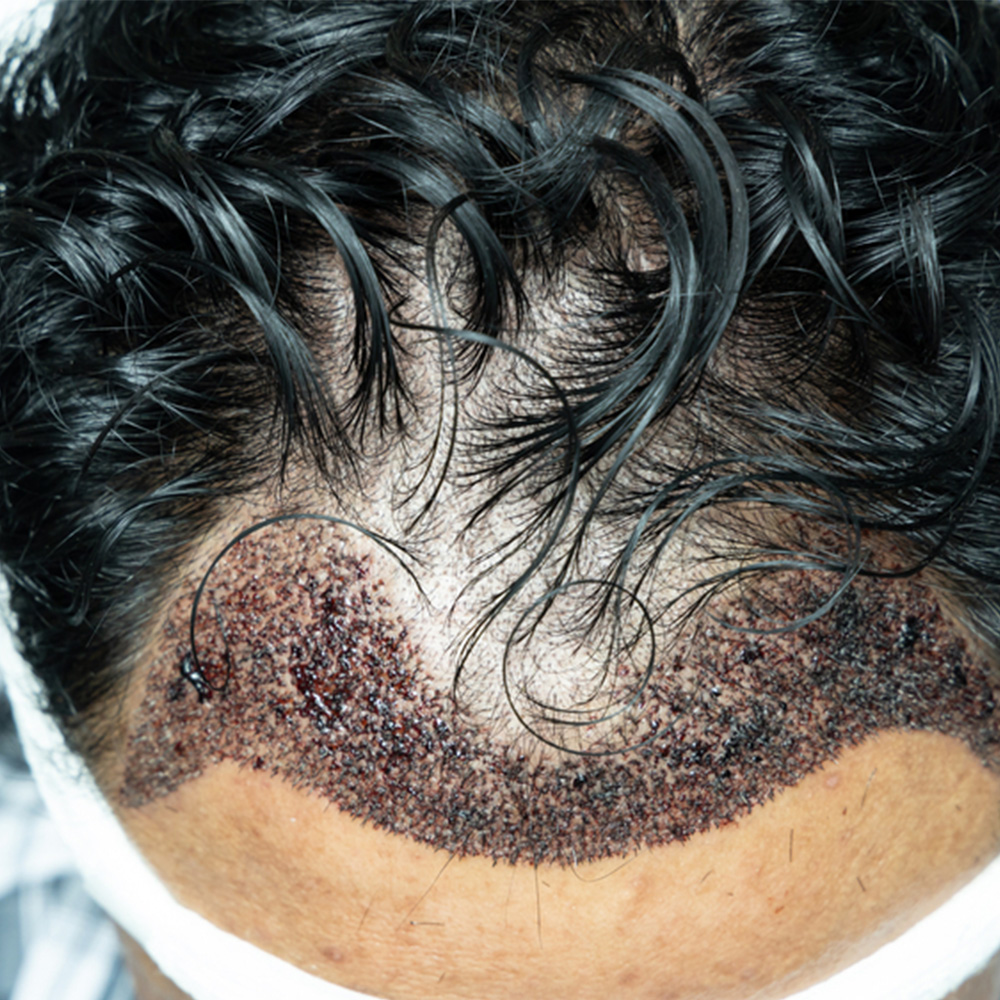
What is DHI Hair Transplantation?
DHI (Direct Hair Implantation) is a procedure in which hair follicles taken from the donor area are transplanted to the recipient area without being kept in the external environment, reducing a two-stage process into a single moment with Choi implanter needles. While in traditional hair transplantation methods, the channel opening and graft placement processes are carried out in completely separate timeframes, in this microsurgical procedure, channels are opened simultaneously with the pushing of the hair follicle under the tissue. This situation reduces the external transit time of the hair follicles to almost zero, maximizing the graft survival rate and operation comfort.
- Simultaneous Process: Channel opening and graft placement are completed in a single mechanical movement.
- Minimum Tissue Damage: Rounded Choi tips open point-like penetrations instead of linear incisions in the skin.
- High Survival Rate: The viability rate of the roots, which do not undergo dehydration by waiting outside, increases radically.
How is DHI Hair Transplantation Performed?
The DHI hair transplantation application is subject to strict clinical stages starting with the microscopic preparation of the donor area (usually the nape area between the two ears) under local anesthesia. First, the follicular units in the donor area are excised one by one by loosening them without damaging the surrounding tissue with the help of medical devices called micromotors. After the collected grafts are classified according to their quality and the number of hair strands they contain, they are placed inside special Choi implanter pens. The expert clinician injects the root into the tissue under the scalp at the correct depth, direction, and angle by pressing the piston mechanism of the pen.
- Donor Extraction: Collecting the roots individually and with a homogeneous distribution using micromotor punch tips.
- Pen Loading: Placing the grafts into the groove of the Choi needle with the help of forceps without getting damaged.
- Implantation: Inserting the pen into the scalp and leaving the root at the exact follicle depth.
Who is DHI Hair Transplantation Suitable For?
The DHI hair transplantation method is suitable for every adult individual whose hair loss stability has been achieved and whose hair follicle density and quality in the donor area are conducive to covering the area to be transplanted. It is an ideal clinical option, especially for patients who have not lost all of their existing hair, have local thinning between the hairs, and do not want their existing hair follicles to be damaged. It shows high compatibility in female pattern hair loss and in individuals who want an unshaven transplantation and need to return quickly to social or work life.
- Those with Local Thinning: Patients who want to densify the spaces between hairs and increase density.
- Those Who Do Not Want to Shave: Individuals who reject having their entire hair shaved to zero due to visual or social reasons.
- Female Patients: Women who need an unshaven operation due to their hair structure and length.
In Which Situations is DHI Hair Transplantation Preferred?
The DHI technique is primarily preferred in cases where there are existing miniaturized (thinned) hairs and healthy hair strands instead of a completely bald ground in the area to be transplanted. In traditional channel opening processes performed with sapphire tips, the risk of mechanical damage to the roots while entering between existing hairs is high; however, the Choi pen can leak between existing hairs millimetrically with its needle structure. It is also the primary choice in cases requiring maximum density and precise direction adjustment in narrow areas such as hairline restorations, temple filling, or beard/eyebrow transplantation.
- Densification Operations: When the blank spaces need to be filled with densification while preserving the existing hair roots,
- Sensitive Area Restorations: For millimetric guidance in eyebrow, beard, mustache, and frontal hairline designs,
- Rapid Healing Expectation: When it is desired to keep the wound healing and scab shedding time to a minimum.
What is the Difference Between DHI Hair Transplantation and Other Methods?
The most radical difference of the DHI method from classical FUE and Sapphire FUE techniques is that the hierarchical phases of the operation are combined, and the necessity of opening micro-channels in the scalp beforehand is eliminated. While in classical methods, the roots taken from the donor are kept in solutions in special petri dishes for hours, in the DHI system, the roots are transplanted to their new home within minutes. This condition does not disrupt the nutritional cycle of the tissue and minimizes the risk of necrosis (tissue death) after the operation. The technical parameters are presented comparatively in the table below:
| Technical Parameter | DHI Hair Transplantation (Choi Pen) | Sapphire FUE Hair Transplantation |
|---|---|---|
| Channel Opening Process | There is no separate phase; it is opened simultaneously with implantation. | Channels are opened in advance with sapphire-tipped medical blades. |
| External Transit Time of Grafts | It is at a minimal level (Average 2 – 15 minutes). | It is long-term (Waits in solution for an average of 2 – 4 hours). |
| Shaving Obligation | There is no need to shave the area to be transplanted. | Generally, both the donor and transplantation areas need to be shaved. |
| Maximum Density (cm²) | Very high (45 – 60 grafts can be placed per cm²). | Medium-High level (30 – 40 grafts can be placed per cm²). |
| Tissue Healing Time | It is fast; point-like holes close in 3-5 days. | It is at a medium level; closing of micro-incisions takes 7-10 days. |
How is the Evaluation Made Before DHI Hair Transplantation?
The dermatological and trichological evaluation performed before the operation decision is made is a clinical analysis phase that directly determines the success of the transplantation. At this stage, with the principle of “Balanced Donor Management”, the graft capacity in the nape area, the micron thickness of the hair strands, and the multiple structures of the follicular units under the microscope are examined. The type of hair loss is diagnosed, and the active state of the shedding phase is analyzed; system parameters are clarified by screening the patient’s chronic diseases and biochemical blood profile to ensure there is no condition constituting an obstacle to the procedure.
- Graft Quality Analysis: Measuring the thickness, density, and root quality of the hair in the donor area.
- Transplantation Area Calculation: Detecting the net number of grafts needed by measuring the sparse area in cm².
- Medical History Screening: Controlling systemic parameters such as blood thinner use, blood pressure, and diabetes.
How is the DHI Hair Transplantation Process Planned?
The planning of DHI hair transplantation requires a mathematical and aesthetic mapping according to the patient’s anatomical head structure, facial proportions, and donor capacity. While planning the frontal hairline, a natural line is drawn by considering the age factor and the movement limit of the forehead muscles. The graft density and orientation angles per square centimeter where the roots will be transplanted are millimetrically clarified during the planning stage.
- Frontal Hairline Design: Drawing a natural boundary suitable for the person’s facial anatomy, which will not look out of place even in old age stages.
- Density Distribution: Planning single and thin roots homogeneously for the front lines, and multiple and thick roots for the inner and back lines.
- Angle and Direction Map: Determining the natural exit directions of the hair and its 40-45 degree angles to the scalp.
How are Grafts Prepared in DHI Hair Transplantation?
The stage of preparing the grafts collected from the donor area for transplantation is a sensitive laboratory phase carried out under cold chain and special medical preservation solutions to preserve cell viability. Roots loosened with the micromotor are gently collected with medical forceps and immediately placed into organ preservation solutions at a temperature of +4°C. Here, they are purified from tissue debris under a microscope and arranged in petri dishes as single, double, and triple units; since this preparation cycle is carried out simultaneously with the transplantation in DHI, the roots stay in the solution for a very short time.
- Tissue Purification: Cleaning the excess epithelial tissue around the roots without damaging the graft.
- Classification: Separating the grafts into single and multiple units according to the number of hair strands they contain.
- Synchronization: Ordering the prepared roots to be transferred to the implanter pens without waiting.
How is the Choi Pen Used in DHI Hair Transplantation?
The Choi implanter pen is a special surgical tool that contains a cylindrical, hollow, and slotted medical needle at its tip, and a spring-loaded piston mechanism at its back. The assistant in the preparation stage places the hair root into the groove of the needle at the tip of the pen; during this time, no mechanical contact is made with the bulb part, which is the main living part of the root. The surgeon, taking delivery of the loaded pen, inserts the needle into the scalp with the correct angle and depth; then pushes the piston at the back of the pen to leave the root inside the tissue and withdraws the pen from the line.
- Precise Loading: Placing the graft into the needle groove with the correct orientation without getting damaged.
- Tissue Penetration: Inserting the needle into the scalp at a micron level without shaking the surrounding tissues.
- Piston Activation: Leaving the root into the hair follicle bed and withdrawing the pen from the line.
How Long Does the DHI Hair Transplantation Procedure Take?
The duration of the DHI hair transplantation operation generally varies between 6 to 8 hours depending on the number of grafts to be transplanted and the loading speed of the implanter pens by the assistants. Although the channel opening and transplantation phases are combined, the loading of each graft into the pen individually by hand and its individual implantation by the surgeon require meticulous and time-consuming craftsmanship. The operation is usually conducted in a continuous rhythm consisting of donor extraction and implantation blocks.
- Small Sessions (1000 – 2000 Grafts): Micro-local restorations lasting approximately 4 to 5 hours.
- Standard Sessions (2500 – 3500 Grafts): Dense transplantations taking an average of 6 to 8 hours.
- Process Distribution: Multiple Choi pens are used alternately during the operation to prevent the duration from extending.
How Many Grafts Can Be Applied in DHI Hair Transplantation?
The maximum number of grafts that can be safely applied in a single session with the DHI technique is generally limited to between 3000 and 3500 grafts (approximately 7000-8000 hair strands) due to the meticulous operation of the implanter pens. While higher numbers can be achieved in a single session with the classical sapphire FUE method, exceeding this limit in DHI may prolong the operation time excessively and reduce the quality of the grafts waiting in the open. If the patient has a wider balding area and the donor area is suitable, the operation should be planned by spreading it over two different days to reach high graft numbers.
- Single Session Limit: Between 2500 – 3500 grafts is clinically the healthiest volume for a single session.
- Tissue Tolerance: Graft density is kept under control to prevent the scalp from becoming excessively traumatized.
- Multiple Session Strategy: Planning a second DHI session 1 year later for massive baldness is more suitable for tissue health.
How Does the Healing Process Progress After DHI Hair Transplantation?
The healing phase after DHI hair transplantation progresses significantly faster and more comfortably compared to traditional methods since linear channel incisions are not opened in the scalp. The formation of micro-scale point-like scabs and a slight edema in the donor and transplantation area right after the operation is a natural reaction of the tissue to the trauma. The healing process begins within seconds on a linear line; the sensitivity in the first days leaves its place to the scab shedding phase as the scalp epithelizes itself rapidly.
- First 3 Days: The phase where the transplanted roots try to hold onto the tissue and edema (swelling) can slightly descend to the face area.
- 10th Day: As a result of special medical washings, all micro-scabs on the scalp are completely shed and relief is provided.
- 1st Month (Shock Loss): The transplanted hair strands break and shed, while the hair roots go into a resting phase under the skin.
What Should Be Considered After DHI Hair Transplantation?
The success of the operation depends on the patient’s full adherence to the medical protection rules to be applied at home in the first weeks as much as the microsurgery performed in the clinic; because it takes about 7-10 days for the newly transplanted roots to completely fuse with the tissue. The smallest mechanical mistake to be made in this process (bumping the head, scratching) can lead to the dislodgement of the roots and permanent losses. The patient needs to isolate the scalp from external factors meticulously.
- Sleeping Position: For the first 5 days, one should sleep on their back at a 45-degree angle (with a double pillow) to prevent the roots from rubbing against the pillow.
- Mechanical Protection: The transplanted area should not receive any impacts for at least 10 days, and harsh scab-picking movements should be avoided.
- Physical Restrictions: Heavy sports, sauna, Turkish bath, solarium, pool, and sea activities are strictly prohibited during the first month.
- Clothing Style: Shirts or zippered clothes should be preferred instead of tight-necked clothes that could pull the roots out of place.
When Does Hair Start to Grow After DHI Hair Transplantation?
The emergence of permanent hair strands on the surface after hair transplantation requires a patient process spread over time, as it is subject to the natural biological growth cycle of the hair follicles. Following the completion of the shock loss phase, starting from approximately the 3rd month, the hair roots pass into the anagen (growth) phase and begin to produce the first thin, down-like permanent hair strands on the scalp surface. This process continues linearly with an increase in hair density and thickness every month.
- 3rd – 4th Months: The first permanent hair strands begin to appear on the scalp (They are usually thin and matte in structure initially).
- 6th – 8th Months: Approximately 60%-70% of the transplanted hair completes its emergence; the hair structure thickens and gains a distinct volume.
- 12th – 18th Months: The final result emerges; the hair regains its original thickness, direction, and completely natural form.
Is Shock Loss Normal After DHI Hair Transplantation?
The sudden and intense shedding of hair strands in the transplanted area between the 2nd and 4th weeks following the DHI hair transplantation operation is called “Shock Loss”, and this situation is a completely normal, temporary, and biologically expected clinical phase. While the hair roots are separated from the donor area and transplanted to their new places, they experience a temporary lack of oxygen and adaptation stress; due to this stress, the follicle takes itself into protection, releases the hair shaft on it, and passes into the resting phase. What sheds is not the root of the hair, but only its temporary shaft; the roots are completely safe under the scalp.
- Biological Reflex: It is a natural cycle renewal step exhibited by the roots while adapting to the new tissue bed.
- Temporary Process: It usually starts in the 1st month after the operation and the shedding stops completely at the end of the 2nd month.
- Safety of the Roots: The shedding hair strands leave their place to coarse hairs that will remain for a lifetime starting from the 3rd month.
What are the Advantages of DHI Hair Transplantation?
DHI technology has numerous certified advantages in modern hair restoration practices in terms of both operation comfort and the quality of aesthetic results. Eliminating the channel opening stage protects the immune system of the tissue and radically elevates the healing coefficient. The naturalness of the hair structure is the biggest reason for preferring this method.
- Unshaven Transplantation Opportunity: It allows regional transplantation between long hairs without shaving the entirety of the hair to zero.
- Maximum Density: Thanks to Choi needles, a very high density and tight placement per cm² can be obtained.
- Low Bleeding Rate: Since point-like penetration is performed, bleeding during the operation and subsequent scabbing are minimal.
- Rapid Healing: The donor and transplantation areas recover quickly as the skin integrity is not exposed to large incisions.
Does DHI Hair Transplantation Provide a Natural Appearance?
Yes, the DHI hair transplantation method is one of the leading techniques that provides the highest level of natural appearance thanks to the absolute mechanical control it offers to the surgeon in mimicking the natural exit directions and angles of the hair. While the directions of the channels opened in traditional methods are fixed in advance, in DHI, the surgeon can instantly change the angle and right/left inclination of the hair at a micron level at the exact millisecond they insert the Choi pen into the scalp. Placing only single grafts on the frontal hairline definitely prevents the formation of an artificial appearance.
- Angular Perfection: Ensuring each hair strand emerges from the scalp at its original angle.
- Front Line Naturalness: Softening the transition by arranging the microscopically thinnest single roots on the forehead line.
- Vortex Harmony: Being able to copy the circular hair rotation directions in the crown area one-to-one with the tip of the pen.
How Should Hair Care Be Done After DHI Hair Transplantation?
The hair care procedures to be applied in the first months after the operation require a medical discipline to support the nutrition of the transplanted roots, repair the donor area quickly, and prevent sebum accumulation on the scalp. For the first 10 days, friction-free washing should be performed with special gentle medical shampoos and panthenol-containing lotions shown in the clinic. In the following months, the process should be supported with clinically registered supplements that will nourish the hair roots from inside and out.
- Medical Washing: A friction-free washing protocol performed with light touches using the palms during the first 10 days, aiming to shed the scabs.
- pH Balanced Shampoos: Selection of special medical shampoos that do not contain chemicals, are paraben and sulfate-free, and nourish the hair roots.
- Clinical Supports: Use of vitamin and mineral supplements to increase hair quality upon doctor’s recommendation.
What are the Anesthesia Methods in DHI Hair Transplantation Operation?
Advanced anesthesia techniques are utilized to make the DHI hair transplantation operation a completely painless and comfortable medical process for the patient. The operation is carried out under local anesthesia; that is, while the patient is fully conscious, only the back and front parts of their head are desensitized. For patients with a fear of needles or a low pain threshold, the session comfort is maximized by using sedation applications or needle-free pressurized anesthesia devices prior to local anesthesia.
- Standard Local Anesthesia: Injecting local anesthetic solutions into the scalp with very fine-tipped medical needles.
- Needle-Free Pressurized Anesthesia: A method where the drug is trapped in the skin through high-pressure spraying technology without using needles.
- Hair Transplantation with Sedation: Zeroing the perception of pain by giving the patient mild muscle relaxant drugs accompanied by an anesthesiologist.
What are the Frequently Asked Questions About DHI Hair Transplantation?
The most common practical concerns arising in the minds of individuals planning to apply for DHI hair transplantation protocols and their uncensored, bare medical counterparts are presented below:
Is a lot of pain felt during the DHI hair transplantation operation?
Thanks to the local anesthesia or sedation support applied at the beginning of the operation, the scalp is completely numbed. After numbness is achieved, the patient does not feel any pain, ache, or soreness during the collection of grafts or transplantation with the Choi pen stages; the operation is completed at a highly comfortable pace.
Will the transplanted hair shed again in the following years?
No, the transplanted hair does not shed. The hair roots in the nape area selected as the donor area are genetically insensitive to the DHT (Dihydrotestosterone) hormone; meaning they have a non-shedding code. Since they retain this genetic feature when transplanted to their new places, the transplanted hair is permanent for a lifetime.
Is it mandatory to shave the hair completely to have a hair transplant with the DHI method?
No, it is not mandatory, and this is one of the biggest reasons why the DHI technique is preferred. Shaving is performed only in the form of a small window in the nape area so that the roots in the donor area can be collected; the area to be transplanted is densified with Choi pens in an unshaven manner while preserving the existing long hair.
How much scar remains on the scalp after DHI hair transplantation?
Since linear channels are not opened in the DHI method and donor extraction is performed with micro punch tips, no visible, permanent scars remain after the operation. The millimetric white scars formed at the extraction points in the nape area are completely hidden among the existing hair and are not noticed from the outside.
When can I return to work and social life after the operation?
Since tissue healing is very fast in the DHI technique, patients can generally return to their normal desk jobs and social life rhythms 2-3 days after the operation. Apart from the appearance of point-like scabs on the scalp for the first 10 days, there is no clinical barrier that constitutes an obstacle to social life.
About Us & Special Demiderm Policlinic
Special Demiderm Policlinic is a licensed health institution that offers corporate health assurance to its clients by blending its long years of clinical experience in the fields of medical aesthetics, dermatology, and hair restoration technologies with registered medical equipment equipment at international standards. It produces high success charts by centering evidence-based medicine disciplines and personalized trichological analyses in DHI Hair Transplantation protocols carried out for the permanent, safe, and recurrence-free treatment of hair loss, thinning, and baldness problems.
In all hair transplantation interventions carried out within Demiderm Policlinic; absolute sterilization, high patient safety, transparency, and medical ethics principles are operated with an uncompromising determination. In our clinical practices, original and high-performance Choi implanter technologies are meticulously calibrated and applied by our expert physician staff according to the patient’s hair baldness degree, donor capacity, and hair strand micron thickness. Our goal is not to offer rote package programs; but to analyze the hair barrier quality of each client with a bare eye to achieve hair designs with maximum session comfort, the highest density, and natural exit angles without damaging the tissue. If you miss the past density of your hair when you look in the mirror and want to start your treatment process with scientific assurance in an expert clinic environment; you can safely protect your health and hair integrity by contacting the expert staff of Special Demiderm Policlinic in line with your detailed hair examination.