
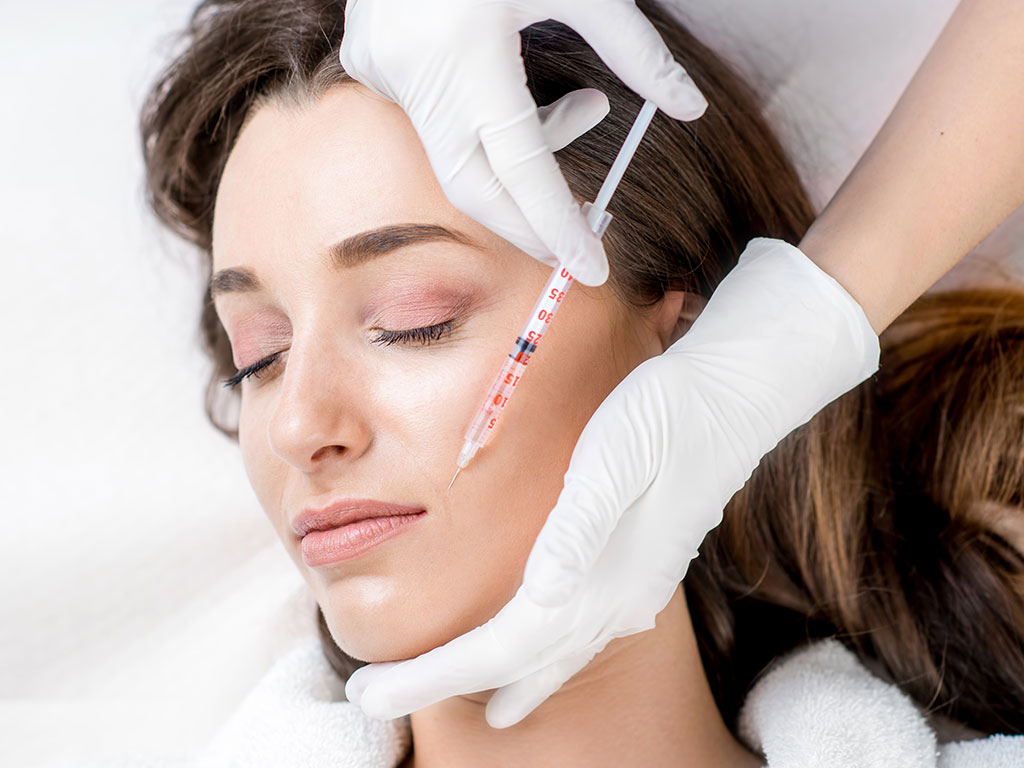
What Are Dermal Filler Applications?
Dermal filler applications are a non-surgical medical aesthetic procedure performed to restore volume lost by the skin during the aging process, soften static wrinkles, and define facial features. In these procedures, various bio-compatible materials are used, primarily hyaluronic acid, which is one of the building blocks of the skin and is known for its water-binding capacity in the extracellular matrix. As we age, fat pads beneath the skin diminish, bone resorption begins, and collagen fibers loosen; filler injections provide structural support to these exact anatomical layers where losses occur, helping the skin regain its former taut and plump form.
- Bio-Compatible Content: Substances that are fully compatible with body tissues and eliminated over time through natural metabolic pathways are used.
- Immediate Effect: A volumetric increase and plumpness in the tissue are observed with the naked eye from the very moment the injection is performed.
- Reversible Structure: Hyaluronic acid-based fillers can be dissolved within seconds using a special enzyme (hyaluronidase) if needed.
For What Purposes Are Dermal Filler Applications Performed?
The primary reason for resorting to filler injections in medical aesthetic clinics is to reverse the aging vectors of the face and reconstruct anatomical symmetry. Depressions created by time and environmental stressors in the subcutaneous soft tissues can make a person look more tired, sad, or older than they actually are. Filler applications are planned with a rational vision to lift sagging tissues (lifting effect) and bring the light-shadow balance of the face to ideal proportions without the need for a surgical facelift operation.
The primary clinical purposes for which filler injections are administered are as follows:
- Eliminating Volume Losses: Giving a more dynamic expression to the face by filling sunken areas such as temples, cheeks, and under-eyes.
- Defining Contours: Revealing the facial oval by sharpening the jawline and cheekbones.
- Amortizing Wrinkles: Filling lines descending from the corners of the mouth (marionette lines) and nasolabial furrows.
- Correcting Asymmetry: Equalizing structural or subsequently developed volumetric differences between the lips or the left-right lines of the face.
Who Are Dermal Filler Applications Suitable For?
Dermal filler applications are suitable for all male and female individuals over the age of 18 who feel a lack of volume in their face, complain of deep wrinkles, and want to define their facial features without surgical intervention. It can be planned as a preventive anti-aging investment in periods when signs of aging are just beginning, or it can be successfully applied for restoration purposes in deep tissue losses at advanced ages. However, filler procedures are not suitable for those who are pregnant or breastfeeding, individuals with active skin infections (herpes, warts, pustules) in the injection area, and people with coagulation disorders.
- Those in Need of Profiloplasty: Individuals who want to bring the aesthetic angle between the nose, lips, and chin to ideal proportions.
- Those Requesting a Quick Social Return: Active working professionals who do not have time to wait for corsets, bandages, or long recovery periods brought on by surgical processes.
- Those with a Tired Facial Expression: Individuals who constantly look exhausted due to depressions and dark circles under their eyes.
To Which Areas Can Dermal Filler Applications Be Applied?
Modern injection technologies and different viscosity (fluidity/hardness) options of filler materials allow for working safely in very diverse anatomical layers of the face and body. While soft fillers with balanced water-retention capacity are preferred in thin-skinned areas, solid gels with high lifting capacity (G-prime) are used in projection shots made onto the bone. This flexibility ensures the holistic rejuvenation of the entire face.
| Application Area | Preferred Layer | Clinical Goal |
|---|---|---|
| Lips and Perioral Area | Mucosa and Submucosa Layer | Providing volume, eliminating asymmetry, and defining the lip contour. |
| Jawline and Chin Tip | Supraperiosteal (Over the Bone) Layer | Extending the facial oval, sharpening the jawline, and camouflaging the appearance of a jowl. |
| Cheekbone and Midface | Deep Fat Pads and Over the Bone | Suspending the midface upward (lifting) and cheekbone projection. |
| Nasolabial Furrows | Dermal and Subdermal Layer | Softening deep aging lines descending from the nasal wings to the corners of the mouth. |
| Under-Eye (Tear Trough) | Supraperiosteal Deep Plane | Filling under-eye hollows and erasing the tired expression. |
Why Is Facial Analysis Important Before Dermal Filler Applications?
Every person’s facial bone structure, muscle resistance, volume of fat pads, and golden ratio parameters present a unique morphology; therefore, rote filler injections can lead to artificial, over-inflated, and un-aesthetic appearances (such as “pillow face” or “duck face”). A detailed facial analysis performed by an expert physician prior to the procedure analyzes the face in three horizontal and five vertical parts, allowing for pinpointing the exact source of the volume deficiency. A correct analysis process shows that in order to eliminate a nasolabial line, filler should not be placed directly into the line, but rather into the cheekbone ligaments that pull it upward (the MD Codes approach); this ensures that the result is completely natural.
- Anatomical Balance: Calculating that the filler moves naturally with the face during dynamic expressions.
- Dosage Management: Preventing the risks of creating tissue sagging (over-filling) by loading too much product onto the skin.
- Vascular Safety: Maximizing injection safety by mapping critical arterial and venous transit routes in the face.
Which Filler Materials Are Used in Dermal Filler Applications?
Filler materials safely used in medical aesthetic clinics vary according to their duration of stay in the tissue and their capacity to trigger biological mechanisms in the lower layers of the skin. The nature of the material to be selected is determined by the physician based on the depth of the deformation in the patient’s skin and the anatomical region to be treated. The table below comparatively summarizes the basic filler raw materials actively used in modern dermatology and their clinical properties:
| Filler Material | Histological Mechanism of Action | Permanence Duration | Most Frequently Preferred Area |
|---|---|---|---|
| Hyaluronic Acid (HA) | Creates volume by binding water molecules in the extracellular matrix. | 6 – 18 Months | Lips, under-eyes, nasolabial furrows, and full face. |
| Calcium Hydroxylapatite (CaHA) | Bone mineral-based; triggers collagen production by stimulating fibroblasts. | 12 – 24 Months | Jawline, chin tip, and cheekbone. |
| Poly-L-Lactic Acid (PLLA) | Biodegradable polymer; initiates a strong collagen remodeling process in the tissue. | 24+ Months | Cheek depressions and full face rejuvenation (fluid liquid filler). |
How Is Lip Filler Applied?
Lip filler is an injection process that requires high technical skill due to the highly sensitive and vascular (rich in blood vessels) structure of the lip mucosa. Prior to the procedure, powerful topical anesthetic creams are applied to block sensory nerves on the lip surface. At the moment of the procedure, fluid fillers containing hyaluronic acid are injected into the lip border (vermilion border) and the inner lip mucosa via very thin 27G or 30G medical needles. The therapist regulates lip symmetry, defines philtrum columns, and balances the lower-upper lip ratio (ideally the 1 / 1.6 golden ratio) using “linear retrograde” or “micro-bolus” techniques.
- Precise Shaping: Defining lip lines and lifting the corners of the mouth (commissures) upward.
- Combination of Moisture and Volume: Thanks to cross-linked hyaluronic acid, dryness and fine vertical lines (smoker’s/barcode lines) on the lips are eliminated.
- Manual Massage: A light shaping massage performed after the injection is finished to prevent the product from clumping inside the mucosa.
How Is Chin Filler Applied?
Chin filler (Mentoplasty) is a powerful structural procedure performed to balance the profile view of the face (profiloplasty) and project a retrusive chin tip forward. In chin tip and jawline injections, firm filler materials with high viscosity and lifting force are preferred. The procedure is generally applied via blunt-tipped cannulas or needles directly onto the bone membrane (supraperiosteal layer) using the bolus technique. This deep plane injection prevents the filler from being felt by hand when viewed from the outside and allows it to create a natural, firm line like an extension of the chin bone.
- Profile Harmonization: Bringing the projection of the nose tip and lips to the ideal aesthetic line (Ricketts’ E-line) with the chin tip.
- Jowl Camouflage: When the chin tip is projected forward and downward, the neck skin tightens and the appearance of a jowl is alleviated non-surgically.
- Cannula Safety: Thanks to the use of cannulas on wide jawlines, risks of vessel damage and bruising are eliminated.
How Is Cheekbone Filler Done?
Cheekbone filler (Malar augmentation) is a lifting application performed to restore the middle third of the face and lift cheek tissues that slide downward with age. In the procedure, deep supraperiosteal injections are made into determined points on the zygomatic arch (cheekbone line). Firm filler molecules left on the bone act as anchors, stretching loose facial ligaments upward. In this way, both the cheekbones are defined to give the face an “attractive lifting” expression, and the pressure on the nasolabial furrow is alleviated, indirectly opening the nose-side lines.
- Midface Projection: Adding a fresher expression to the face by ensuring that light falls on the cheekbones at the correct angle.
- Anti-Sagging Effect: Preventing accumulations in the lower face area by suspending cheek tissues upward.
- Natural V Volume: The process of restoring the face to its ideal inverted triangle form from its youth years.
What Is Nasolabial Filler and How Is It Applied?
Nasolabial filler is the process of softening deep anatomical furrows, referred to as smile lines, starting right next to the nasal wings and descending to the corners of the mouth. These furrows deepen as a result of cheek fat pads sagging downward with age and the skin folding along the sag line. In treatment, medium-firm density hyaluronic acid fillers are injected into the subdermal or deep dermal plan using the “tunneling” or “linear retrograde” technique. Bolus shots made particularly into the pyriform space (deep pyriform space) next to the nasal wing during the procedure quickly elevate the deepest starting point of the furrow, erasing the tired facial expression.
- Furrow Filling: Ending shading and the expression of old age with support placed beneath the folding line.
- Holistic Approach: For the best clinical result, nasolabial filler is usually planned in combination with cheekbone filler.
- Expression Flexibility: Flexible HA fillers are selected so that an artificial mass appearance does not form on the face when speaking or smiling.
How Is Under-Eye Light Filler Applied?
Under-eye light filler is an extremely sensitive and specialized clinical procedure performed to treat depressions, tear trough deformities, and dark circles developing accordingly in the periorbital (around the eyes) area. Since under-eye skin has the thinnest skin layer of the body, standard fillers can absolutely not be injected here; special hyaluronic acid formulations with deliberately low water-retention capacity (non-edematous) and containing amino acids, vitamins, and antioxidants are used. In order not to damage the dense vascular network around the eyes and to zero the risk of major complications such as blindness, the procedure is applied by sliding under the skin from a single entry point via blunt cannulas that are not sharp, placing the product onto the bone membrane (deep plane).
- Prevention of the Tyndall Effect: The necessity of deep injection to prevent purple/blue reflections that occur if the filler is placed too superficially.
- Cellular Nourishment: Permanent vitalization in under-eye dark circles and skin quality thanks to amino acid chains in the filler content.
- Zero Edema Strategy: With special gels whose hygroscopic (water-attracting) feature is minimal, risks of post-procedure under-eye bagging are eliminated.
How Long Do Dermal Filler Applications Take?
Thanks to their non-surgical minimally invasive characteristics, filler injections are extremely fast clinical procedures categorized in modern time management as “lunchtime procedures.” The active injection process is generally completed within 15 to 30 minutes, depending on the width of the area to be treated and the number of grafts (syringes). The absolute majority of the session duration consists of the absorption (waiting) stage of the topical local anesthesia cream applied beneath the skin to maximize the patient’s procedure comfort.
- Anesthesia and Preparation Phase: 20 – 30 Minutes (Waiting for the topical numbing cream and skin disinfection).
- Active Injection Phase: 15 – 20 Minutes (Performing needle or cannula shots and placing the product into the tissue).
- Closing and Soothing: 5 Minutes (Cold compress application and spreading restorative medical creams).
How Does the Healing Process Progress After Dermal Filler Applications?
Following filler injections, there is no exhausting healing burden requiring patients to stay in bed and rest; however, because an external volume is placed beneath the tissue, temporary local reactions given by the nervous and vascular systems to this situation are a natural part of the healing phase. Slight pinkness at injection points, micro-edema (swelling) due to needle stimulation, and small bruises (ecchymosis) caused by capillary leakage may occur right after the procedure is finished. This presentation exhibits a tendency to quickly fade away on a linear path, and tissue integrity soon reaches its permanent balance.
- First 24 – 48 Hours: This is the phase when edema is most intense (It is normal to wake up with a temporary swelling the next morning, particularly in lip fillers).
- 3rd to 5th Days: Bruises, if any, disappear by turning yellow, and the filler material beneath the tissue begins to soften and take its own natural consistency.
- 14th Day (Final Integration): The filler fully integrates with the extracellular matrix, establishes its water-retention balance, and the skin reaches its most stable form for the touch-up session (control).
What Should Be Considered After Dermal Filler Applications?
The care discipline to be followed by the patient in the home environment after the procedure is of vital importance in order to preserve the success of the injection session, prevent the product from displacing (migration) in tissue spaces, and zero the risks of infection. Since the gel newly placed beneath the tissue is not yet fully stabilized, aggressive mechanical moves or heat loads to be made on the area in the first days can directly sabotage the aesthetic output of the treatment.
Critical medical rules that must be meticulously followed after the filler session are as follows:
- Water should absolutely not touch the injected areas, makeup should not be applied, and the face should not be washed for the first 24 hours after the procedure.
- To prevent the filler from displacing, one should not sleep face down for the first 3 days; a suprapine position should be preferred.
- Saunas, Turkish baths, solariums, hot showers, steam rooms, and heavy cardio sports activities that increase edema should be discontinued for at least 1 week.
- Harsh massages should not be performed on the treated areas in the first days, the face should not be rubbed, straws should not be used after lip filler, and very hot foods should not be consumed.
How Long Does the Effect of Dermal Filler Applications Last?
The permanence duration of filler injections in the tissue varies depending on the chemical structure of the material used (cross-link density), the hardness degree of the filler, the mobility coefficient of the anatomical region where it is injected, and most importantly, the personal metabolic rate of the patient. While fillers near muscle groups that are dynamic and in continuous motion (e.g., lips) are dissolved faster by the hyaluronidase enzyme, the lifespan of fillers in immobile areas over the bone (e.g., chin, cheekbone) is much longer. Regularly repeated sessions kumu-latively extend the permanence durations because they also indirectly trigger collagen production.
- Lip Filler Permanence: Generally ranges between 6 to 12 months due to the highly mobile mucosal structure.
- Nasolabial and Cheek Fillers: Since medium-firm gels are used, the effect remains stable for an average of 10 to 14 months.
- Chin, Jawline, and Cheekbone Fillers: The permanence of firm fillers placed in the deep supraperiosteal plane can extend up to 12 to 18+ months.
What Are the Advantages of Dermal Filler Applications?
Among non-surgical face shaping alternatives, filler injections are the most popular application of modern medical aesthetics with both the instant visual satisfaction it offers to the patient and its high safety profile that does not involve surgical risks. Replacing the missing volume by respecting the natural anatomical structure of the skin makes this method one of the most rational and rapid solutions against the effects of aging.
- No Surgical Burden: It does not involve general anesthesia, operating room risks, incision scars, and recovery room processes.
- Results Are Seen Instantly: It is observed with the naked eye that hollows are filled and the line is defined at the exact minute one steps out of the session room.
- Reversibility: In moments of dislike of the result or rarely developing vascular complications, the filler can be dissolved within seconds with the hyaluronidase enzyme.
- Low Social Disruption: Even on the day of the procedure, the patient can comfortably continue their work or social invitations from where they left off.
Do Dermal Filler Applications Provide a Natural Appearance?
Yes, dermal filler applications provide a completely natural “authentic fresh look” that is not understood to be treated when viewed from the outside, provided that correct anatomical planning, loyalty to the patient’s facial proportions, and the correct product selection with the appropriate G-prime (viscoelasticity/hardness) value are made. The sole rule of naturalness is to use the filler not to bloat the face, but only to carry sagging tissues to their former anatomical coordinates and to amortize hollows caused by bone loss. Modern dynamic fillers placed in compliance with the movement directions of facial muscles do not stand like an artificial mass on the face when the person smiles or speaks, but stretch together with mimes.
- Layering Technique: Homogeneously distributing the product in micro-doses to layers of different depths instead of giving it abundantly to a single point.
- Golden Ratio Control: Illuminating only shaded and tired areas without disrupting the patient’s natural characteristic facial lines.
With Which Aesthetic Procedures Can Dermal Filler Applications Be Planned Together?
Filler injections can be planned in a combined synergy with other medical aesthetic protocols in order to holistically elevate the transdermal quality of the skin and the rejuvenation architecture of the face. While fillers fill volume deficiencies and static wrinkles in the lower layers of the face, dynamic muscle movements or skin laxity in the upper layers can be simultaneously treated with different technologies. The combination schedule is designed according to the result of the detailed facial analysis to be performed by the specialist physician.
- Botulinum Toxin (Botox): While expression wrinkles (forehead, crow’s feet) are halted with botox, established deep furrows are filled with filler to provide full smoothness.
- Diamond Face Lift / Radiofrequency: While the upper layer of the skin is tightened and suspended upward with energy-based systems, filler support is thrown into the hollows remaining beneath the sagging lines.
- Youth Vaccines / Mesotherapy: While facial features are shaped with fillers, the moisture, radiance, and collagen quality of the entire skin are increased with mesotherapy cocktails.
Safety and Vascular Risk Management in Dermal Filler Applications
Although filler applications appear to be non-surgical and practical procedures, the scalp and facial anatomy are woven with a multitude of major arterial and venous (blood vessel) networks; therefore, it is a vital necessity that the procedure be performed strictly in clinical environments by specialist physicians with deep knowledge of anatomy. There is a risk of developing “Vascular Occlusion,” i.e., blood vessel blockage, as a result of accidentally injecting the filler substance inside a blood vessel or applying excessive external pressure on the vessel during injection. In a safe clinical process, the physician performs a negative aspiration check before each shot and eliminates the possibilities of vessel puncture by using blunt-tipped tools (blunt cannulas) instead of sharp needles in risky areas.
- Emergency Hyaluronidase Protocol: The moment a vessel blockage signal such as blanching or bruising on the skin is noticed during the procedure, the physician instantly injects hyaluronidase to dissolve the filler and restores blood flow within seconds.
- Clinical Infrastructure Mandatory: Keeping complication management kits (anticoagulants, hot compresses, dissolving enzymes) fully ready in the clinic.
What Are the Frequently Asked Questions About Dermal Filler Applications?
The most common practical concerns arising in the minds of people planning to resort to filler injections to clarify facial features or eliminate volume losses and their uncensored, bare medical counterparts are as follows:
Do filler injections cause a lot of pain or ache during the session?
Prior to the procedure, clinically powerful local anesthetic (numbing) creams are applied to the skin and expected to numb for an average of 20-30 minutes. In addition, a local anesthetic substance (lidocaine) is also included within the formulation of the premium medical filler syringes used today. Thanks to this two-stage numbing, patients feel only a slight pressure and placement sensation at the moment of injection; unbearable pain is absolutely out of the question.
Is it normal for lumpiness or hardness to remain in the tissue after having fillers?
Feeling slight hardnesses or small marble-like lumps beneath the tissue for the first 1-2 weeks following the injection is a completely normal and expected healing process; because the filler gel has not yet fully integrated with the water molecules of the surrounding tissues. The patient should not rub the area harshly during this process. Within an average of 14 days, the filler softens completely, integrates with the tissue, and reaches a consistency that cannot be felt by hand.
Does the skin sag more after hyaluronic acid fillers dissolve completely?
No, this is a medical dezenformation that is absolutely not true. Throughout the months they remain in the tissue, hyaluronic acid fillers mechanically stretch fibroblast cells, triggering new, natural collagen production (neocollagenesis) in that area. Even when the filler substance dissolves completely and is eliminated from the body, more collagen bonds remain compared to before the procedure; therefore, your skin does not go worse than its former state, on the contrary, the aging rate is slowed down.
How can I be protected from an artificial, swollen-looking “duck lip” or “pillow face” appearance?
The primary cause of these artificial appearances is the faulty execution of facial analysis and loading an excessive dose (over-filling) of product above the anatomical carrying capacity of the skin. The sole way to maintain the natural form is to progress gradually (layering) by spreading procedures over time instead of emptying a large number of syringes in a single session, and to stay absolutely loyal to the natural boundaries and golden ratio parameters of the skin.
Can one return to normal life and work on the day the filler injection is performed?
Yes, following filler applications, it is not necessary for the patient to be hospitalized or rest at home. As soon as the session finishes, restorative creams are applied to the wound sites and the patient can immediately continue their social, professional, or academic life from where they left off at that very minute; protecting the face in the first days and avoiding excessive heat are practical details that will not affect social comfort.
About Us & Special Demiderm Policlinic
Special Demiderm Policlinic is a licensed health institution that offers corporate health assurance to its clients by blending its long years of institutional experience in the fields of dermatology, medical aesthetics, and non-surgical face shaping technologies with registered medical device and product equipment at international standards. It produces permanent, rational, and safe results by centering evidence-based medicine disciplines and personalized dermatological facial analyses in Dermal Filler Applications protocols carried out for the restoration and profile harmonization of facial features sagging or shadowed due to aging, gravity, and volume losses.
In all medical injection interventions carried out within Demiderm Policlinic; absolute sterilization, high patient safety, transparency, and honesty principles are operated with an uncompromising determination. In our clinical practices, only FDA-approved premium hyaluronic acid and smart filler formulations whose worldwide reliability and tissue biocompatibility have been certified are administered with millimetric dosage calibrations by our expert physician staff according to the patient’s sagging degree, asymmetry map, and skin phototype. Our goal is not to turn everyone into look-alike artificial facial forms by offering rote package programs; but to analyze the quality of each client’s own authentic facial anatomy with a bare eye to achieve maximum session comfort and the highest natural smoothness without damaging tissues and vascular pathways. If you are tired of seeing the dark circles under your eyes, the shadows of your nasolabial furrows, or a jawline that has lost its clarity when you look in the mirror and want to start your treatment process with scientific assurance in an expert clinic environment; you can safely initiate your journey of change and permanent smoothness by contacting the expert staff of Special Demiderm Policlinic in line with your detailed facial analysis.