
Is Laser Mole Removal Safe in Bornova?
Bornova, the heart of İzmir’s educational and social life, always has a vibrant atmosphere thanks to the high concentration of young people brought by the Ege University campus, the energy of Küçükpark, and the established order of Özkanlar. Those living in this dynamic district are known for the importance they place on their appearance and personal care. Moles (nevus) located in visible areas such as the face, neck, or hands can be both an aesthetic concern and a health concern that constantly raises the question of “is it dangerous?”. With the advancement of technology, “laser mole removal” (Laser Ablation) has become one of the most frequently inquired-about procedures in clinics in Bornova due to its bladeless and stitchless nature. However, the answer to the question “Is laser mole removal safe?” requires much more than a simple “yes” or “no,” and necessitates a deep medical analysis. Safety is not determined by the brand of the device; It depends on which mole the device is used on, by whom, and for what medical reasons.
The procedure known as “laser mole removal” among the public is actually a medical “vaporization” procedure. The laser beam (usually CO2 or Erbium lasers) targets the water in the mole tissue, vaporizing the tissue layer by layer. While the absence of stitches and the comfortable healing process make this method attractive, the golden rule in dermatology is: “No suspicious lesion should be vaporized.” Because vaporized tissue cannot be sent to a pathology laboratory and examined under a microscope. Therefore, the safety of laser mole treatment depends more on the “diagnostic accuracy” achieved before the procedure than on the procedure itself.
The Safety Paradox: Which Moles Can Be Treated with Laser?
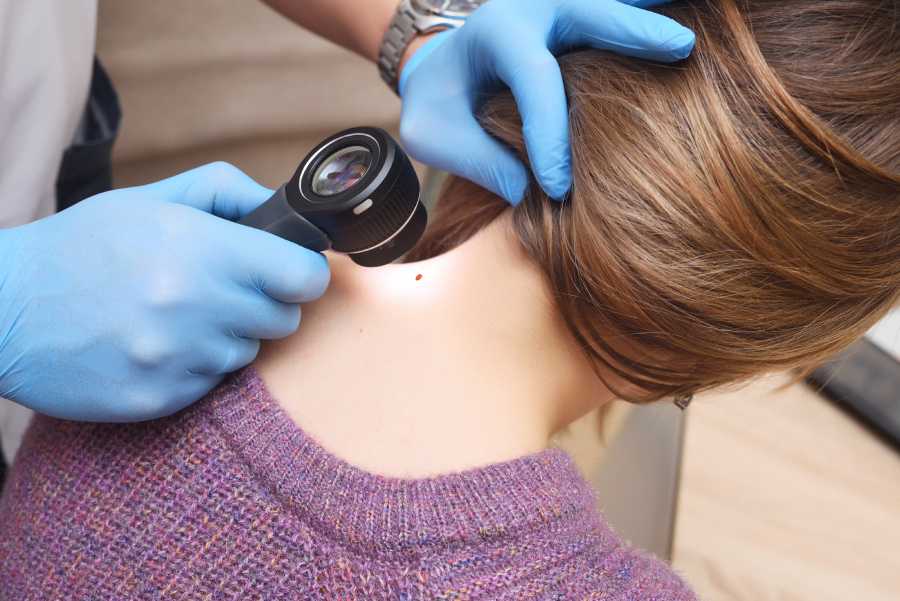
Whether a mole is suitable for laser treatment should be determined not by the person looking in a mirror, but by a specialist physician examining it with a special magnifying glass called a “dermatoscope.” The dermatoscope shows the pigment distribution in the lower layers of the skin, giving the physician vital clues about the structure of the mole.
Laser treatment is a safe option for lesions that have been 100% medically proven to be “benign” (non-cancerous). These are generally:
- Dermal Nevi: Raised, skin-colored or light brown, mole-like formations on the skin surface, usually on the face, and that do not change for years.
- Epidermal Nevi: Flat moles located in the upper layer of the skin, confirmed to be benign with a dermatoscope (Lentigo, etc.).
- Seborrheic Keratosis: Benign lesions that appear with age, appear to be attached to the skin, and are bumpy.
Red Line: When Should Laser Not Be Done? If a mole is asymmetrical, has irregular edges, is mottled in color (mixed black, brown, red), has a large diameter, or has recently changed (ABCD Rule); laser should NEVER be applied to these moles. If these types of “dysplastic” (risky) moles are burned off with a laser, evidence of an underlying potential skin cancer (melanoma) is destroyed. Although the cancer cells appear to be removed from the surface, they can continue to progress deeper. In this case, the safety breach stems not from the device, but from incorrect patient selection.
Surgery vs. Laser: A Comparison of Safety and Aesthetics
The most frequent dilemma for clients considering mole removal in Bornova is “Surgery or Laser?”. The table below compares these two methods in terms of safety and aesthetics.
| Features | Laser Mole Treatment (Ablation) | Surgical Excision (Surgery) |
|---|---|---|
| Procedure Principle | Vaporizing the tissue with heat. | Cutting and removing the tissue and suturing. |
| Pathology Examination | Not Possible (Tissue is destroyed). | Absolutely Done (Tissue is examined). |
| Safety Profile | Safe only for definitively benign moles. | The safest method for all suspicious and risky moles. |
| Scaring | Usually a slight depression or discoloration may occur. | A thin, linear surgical scar remains. |
| Healing Time | Crusting takes 1 week. | Stitches are removed in 1-2 weeks. |
Bornova Climate and Post-Laser Safety
The safety of the procedure is not limited to the moment of application; the post-operative care process is also part of the safety. Bornova is a region that receives sunshine for a large part of the year. The area where laser treatment is applied is vulnerable to UV rays because the skin’s protective layer is temporarily removed. If exposed to the sun after the procedure, permanent brown spots called “Post-Inflammatory Hyperpigmentation” may form.
Therefore, laser treatment in Bornova…The safest time for mole removal is during the autumn and winter months when the sun’s effect is reduced. If it must be done in the summer, covering the treated area with a hat or clothing and using a high-factor sunscreen is essential for “aesthetic safety”.
Roadmap to Follow to Avoid Risks
If you are considering laser mole removal in Bornova, it is recommended that you follow these steps to ensure the process proceeds safely:
- Choosing a Specialist: Make sure that the person performing the procedure is a “Dermatologist” or “Plastic Surgeon”. It is not medically or legally appropriate for beauty specialists or non-physicians to diagnose moles and perform laser treatment.
- Dermatoscopic Examination: Confirm that your doctor has examined the mole with a dermatoscope before the procedure. Naked-eye assessment may not always be sufficient.
- Surgery if There is Doubt: If your doctor sees even the slightest suspicious structure (atypical cells) in me, give up insisting on laser and accept the surgical method. Health comes before aesthetics.
Are There Any Side Effects of Laser?
Laser is an extremely controlled power in the right hands. However, as with any medical procedure, there are potential side effects. A slight depression (atrophy) may occur after the procedure, but this depression fills up over time as the skin repairs itself. Sometimes, lightening (hypopigmentation) or darkening (hyperpigmentation) of the color may be seen in the treated area. The risk of infection is low, but it can develop if hygiene rules are not followed.
One of the most frequently asked questions about laser treatment is whether the mole will recur. Because going too deep into the skin with a laser increases the risk of scarring, doctors usually stop at a safe depth. If the pigment cells of a mole go too deep, a small amount of pigmentation (recurrence) may be seen at that point over time. In this case, a second touch-up session may be necessary. This is not a failure, but a result of the principle of safe operation.Conclusion: Information is Trust
In conclusion, laser mole removal in Bornova is a modern, fast, and aesthetically pleasing, safe method for correctly diagnosed benign moles. However, the key to this safety is not in the device, but in the expertise of the physician who made the diagnosis. When you go with the request “I want to have my mole removed,” your priority should be “what it is pathologically” before “how it will look.” In clinics committed to medical ethics, laser is not applied to any suspicious lesion that would risk your health; if there is doubt, the scalpel speaks, pathology has the final say.