
Why is Alexandrite Laser Preferred for Dark Hair in Karşıyaka?
Karşıyaka, a district of İzmir synonymous with modern lifestyle, is home to a population that, with its unique “Karşıyaka” identity, pays a high level of attention to aesthetics and personal care. For a wide range of people, from those strolling along the Bostanlı coast to those rushing to the busy work pace in Mavişehir, managing unwanted hair is not only an aesthetic choice but also a hygienic necessity and an element of quality of life. Among laser hair removal technologies, Alexandrite laser systems, considered the “Gold Standard” especially for the combination of light skin and dark hair frequently found in the genetic makeup of Turkish people, are among the most frequently inquired about and researched methods in clinics in Karşıyaka.
The basic principle in laser hair removal applications is based on a scientific principle called “Selective Photothermolysis”. This principle states that light energy at a specific wavelength finds and heats only the targeted structure (chromophore) without damaging surrounding tissues. When it comes to hair removal, our target is the “melanin” pigment located in the hair follicle, which gives the hair its color. This is precisely where the secret of the Alexandrite laser lies. Compared to other laser types, it has one of the wavelengths with the highest absorption by melanin, making it extremely selective and effective on dark-colored (i.e., melanin-rich) hairs. However, this power can also bring risks if not used correctly. Therefore, it is of great importance for informed individuals considering this procedure in Karşıyaka to understand how the technology works.
Melanin Absorption and 755 Nanometers: What Do the Laws of Physics Say?
The success of laser hair removal depends on whether the energy sent reaches the hair follicle. For the hair follicle to be destroyed, the energy must travel along the hair shaft and heat the growth centers (bulbus) in the root. The medium that enables this heat transfer is the “melanin” pigment. Black and dark brown hairs contain a high concentration of melanin. Alexandrite lasers produce light at a wavelength of 755 nm (nanometers). This specific wavelength is absorbed with “perfect” efficiency by the melanin pigment. To explain it physically, when the light from the Alexandrite laser hits the skin, it quickly penetrates the skin’s surface and is absorbed by the dark hair as soon as it encounters it. This absorption causes the light energy to convert into heat energy within milliseconds.
We can compare this process to a black car heating up much more in the sun than a white car. The Alexandrite laser heats the hair on your skin rapidly, treating it like that “black car.” The protein denaturation (structural breakdown) that occurs in the heated hair follicle causes the hair to lose its ability to grow. Therefore, the darker the hair (the more melanin it contains) and the lighter the skin (so the laser can pass through without lingering), the more successful the Alexandrite laser results. The fact that individuals in the Karşıyaka region generally have a wheat-colored complexion and dark hair explains why this technology is the primary choice in the area.
Why Dark Hair and Not Fine and Light Hair?
The answer to the frequently asked question, “Why doesn’t it detect my light-colored hairs?”, is also hidden in this physical principle. The Alexandrite laser is not a “blind” energy source; however, its target is only melanin. Light, white, red, or very fine vellus hairs have very little or no melanin. When there is no target (pigment), the laser beam passes through the hair but cannot generate heat. When no heat is generated, the root is not destroyed. Therefore, the Alexandrite laser performs at its maximum thanks to its “high contrast” advantage, especially in areas with dense thick and dark hair such as the armpits, genital area, and legs. In contrast, using this laser on fine facial hair can sometimes lead to a condition called “paradoxical hypertrichosis,” where fine hairs are triggered to thicken. Therefore, hair structure analysis is vital for choosing the right technology.
Karşıyaka Lifestyle and Application Practicality
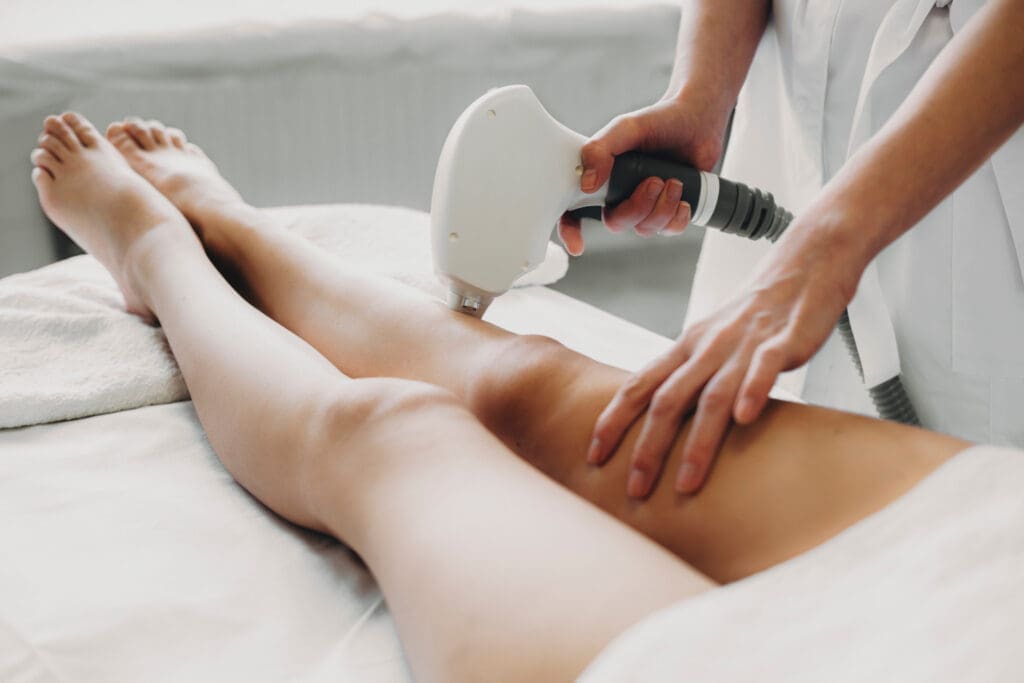
Time management is important for those living in Karşıyaka. Another reason why Alexandrite lasers are preferred for dark hair is the “Practicality and Speed” factor. These systems generally work with heads that can fire remotely without touching the skin. Devices that work integrated with air cooling systems minimize the feeling of pain and protect the skin by blowing strong cold air on the skin at the moment of firing. Because it transmits energy very quickly on dark hair, scanning large areas (e.g., the entire leg or back) can be completed in a shorter time compared to other systems. For Karşıyaka residents who work in plazas or have busy social lives, being able to schedule sessions even during lunch breaks is a great advantage.
Most Alexandrite lasers do not require the application of gel to the skin and the head does not make full contact with the skin (a certain(It fires from a distance). This feature is an extra reason for preference for individuals with high hygiene sensitivity. You can return to social life immediately after the session without the hassle of gel cleaning.Comparative Analysis of Technologies: Why Alex?
Knowing the differences between laser types used in skin health and aesthetics makes it clearer why Alexandrite stands out for dark hair. The table below summarizes the key differences between the 755 nm wavelength and other systems.
| Laser Type / Wavelength | Melanin Absorption Level | Ideal Target Audience | Advantage in Dark Hair |
|---|---|---|---|
| Alexandrite (755 nm) | Very High | Light Skin (Type I-III) + Dark Hair | Because it sees melanin best, it gives the fastest and most effective result. It can vaporize the hair on the surface. |
| Diode (810 nm) | Medium – High | All Skin Types (Including Bronze) | It penetrates deeper but melanin absorption is not as explosive as Alex. Applied with gel. |
| Nd:YAG (1064 nm) | Low | Very Dark Skin (Type V-VI) | Sees less melanin, so it is safe on dark skin, but not as aggressive as Alex on dark hair. |
Skin Type Limitations and Safety Protocols
This superior success of the Alexandrite laser on dark hair also brings with it an important limitation: Skin Color. Because the laser beam targets melanin, if there is also a high concentration of melanin in the skin itself (i.e., if the person is dark-skinned or tanned), the laser beam may have difficulty distinguishing between the hair follicle and the skin surface. This can cause the energy to be absorbed on the skin surface and create a risk of burns.
Therefore, in sunny regions like Karşıyaka and İzmir, the ideal candidates for Alexandrite laser treatments are individuals with light skin tone (Fitzpatrick Type I, II, III) but dark hair. Applying Alexandrite treatment to tanned skin during the summer months is medically risky and not recommended. Sessions should be interrupted until the tan fades or the person’s skin tone lightens, or a switch to different wavelengths (e.g., Nd:YAG) should be made. For a safe application:
The area to be treated must not have been sunbathed in the last 3-4 weeks,
The person must not have used a tanning bed,
The hairs must not have been removed from the root (waxing, plucking, etc.).
Conclusion: Right Hair, Right Skin, Right Technology
In conclusion, the preference for Alexandrite laser treatment among individuals with dark hair in Karşıyaka is not a coincidence, but a conscious choice based on physical realities. The high affinity of the 755 nm wavelength for melanin ensures the most effective, fast, and comfortable results in candidates with light skin and dark hair. However, the success of the technology depends on the correct patient selection. Even with successful results on dark hair, the skin tone must also be suitable for this energy level.
Combating unwanted hair is not just a matter of equipment, but also a matter of expertise. Analyzing your skin type, evaluating your hair structure, and managing seasonal conditions (sun exposure) requires a professional approach. To get the best results from these technologies offered in clinics in Karşıyaka, it is essential that the application is performed under the supervision of competent healthcare professionals in centers that meet hygiene standards.