
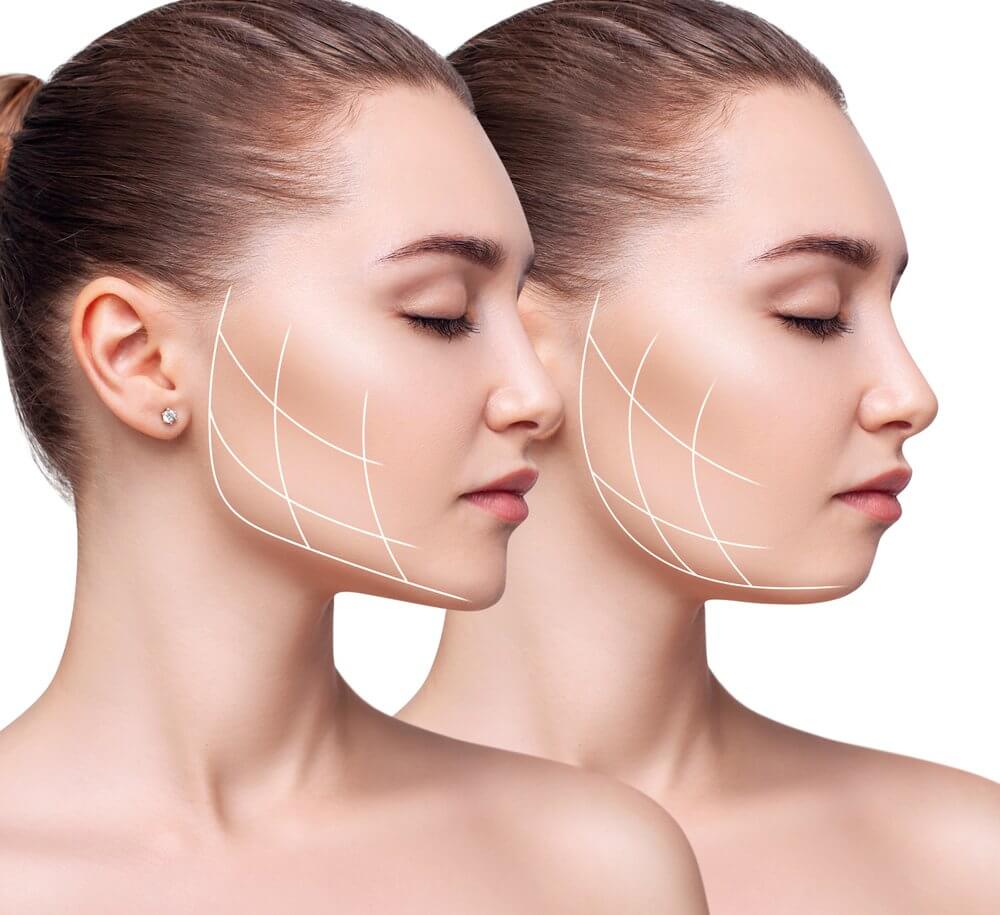
There’s a hidden hero who plays a role as critical as, or sometimes even more critical than, the eyes and lips in the perception of facial beauty: the jawline. A strong, sharp, and defined jawline not only gives a person a younger and fitter appearance but also symbolizes “character” and “self-confidence” in the face. However, genetic factors, structural features, or bone loss that comes with aging cause many of us to have a blurred jawline, a more pronounced double chin, and a face that appears to merge with the neck. This is where “Jawline Filler,” one of the most popular medical aesthetic trends of recent years, comes into play. So, what exactly is this procedure behind the sharp profiles of Hollywood stars? How can the geometry of the face be changed without surgical intervention? In this comprehensive guide, we examine the jawline application, the most effective weapon of facial engineering, with all its technical and aesthetic details.
What is Jawline Filler? Redefining the Face’s Frame
Jawline filler is a filler injection procedure performed along the mandibular bone line, extending from the chin to the front of the ear, aiming to reshape the lower 1/3 of the face. This procedure is classified as “Contouring” in aesthetic medicine. Its purpose is not only to add volume but also to define the bone line that frames the face, clarifying the separation between the face and the neck.
While this procedure is in high demand by both women and men, aesthetic goals differ according to gender. In women, the aim is to create a more elegant, “V-Shape” (inverted triangle) face shape, slightly sharpening the chin and concealing the appearance of a double chin. In men, the goal is different; it aims to widen the jaw corners to create a more masculine, strong, and square faceline (Texas Jawline). Regardless of gender, the basic principle is to achieve the “Golden Ratio” in the face.
Why is it Needed?
The Source of the Problem
Jawline problems generally stem from two main causes. The first is “Structural Reasons”; some people are born with a receding (retrognathi) or small (micrognathi) chin. This makes the nose appear larger than it is and the face seem disproportionate. The second is “The Aging Process”. With age, the bone tissue in our face erodes and the ligaments holding the skin loosen. Due to the effect of gravity, the cheeks sag downwards (bulldog cheek appearance) and the jaw contour becomes indistinct. Jawline filler lifts these sagging tissues back up (Lifting Effect), providing both rejuvenation and camouflaging structural imperfections.
Step-by-Step Application Process: How is Jawline Filling Done?
Although jawline filler may seem like a simple needle procedure, it involves serious anatomical knowledge and artistic vision. Because it is one of the areas of the face with the most blood vessels and nerves, it is a procedure that must be performed by experienced hands. Here’s the step-by-step process:
1. Facial Analysis and Mapping
The success of the procedure lies in the planning phase before the injection. Your doctor will sit you down and photograph your face from different angles. The degree to which your chin is recessed, any asymmetries, and other facial proportions (nose, forehead, lips) are evaluated. Using a technique called “MD Codes,” the points, amount, and depth of filler injection are marked on the skin with special pens.
2. Anesthesia and Preparation
Patient comfort is paramount. The area to be treated is cleaned with antiseptic solutions and a strong local anesthetic cream is applied. After waiting approximately 20 minutes, the area becomes numb. Since jawline fillers are usually injected into the bone (supra-periosteal), a deep plane is worked on; therefore, the filler usually contains lidocaine (numbing agent). This minimizes pain during the procedure.
3. Injection Technique: Cannula or Needle?
Modern techniques in jawline treatment encourage the use of a “cannula.” A cannula is a long, blunt (non-sharp) instrument. A single entry point is made on the skin, and the cannula is inserted through this point and advanced along the entire jawline. Because the tip of the cannula is not sharp, it does not cut blood vessels and nerves, but goes around them. This reduces the risk of bruising to almost zero and ensures a much safer procedure. Your doctor places the dense (firm) filler material onto the bone along the determined line.
4. Shaping and Massage
After the filler material is placed, your doctor shapes the area with their hands (molding). This stage is critical for the filler to sit perfectly on the bone line and look smooth. The patient sees the result immediately when they look in the mirror.
Filler Materials Used: What is Injected?
The jawline area has a firmer and more bony structure compared to other areas of the face (e.g., lips). Therefore, the filler used here must have a high “Lifting Capacity” (G Prime), be firm and dense. Generally, two types of materials are preferred:
- High Molecular Weight Hyaluronic Acid: The most commonly usedIt is the most used and safest material. It is fully compatible with the body and can be dissolved in case of adverse effects. Its duration is approximately 12-18 months.
- Calcium Hydroxyapatite (Mineral Injection): It belongs to the semi-permanent filler group. It not only provides volume but also stimulates collagen production, mimicking bone structure. It can be preferred for those who want sharper lines.
Jawline Filler vs. Jaw Surgery (Implant)
Filler is not the only option for shaping the jawline; surgical implants or fat injections are also alternatives. But why do 90% of patients choose fillers? The following table clarifies this comparison:
| Feature | Jawline Filler (Non-Surgical) | Jaw Implant / Filing (Surgical) |
|---|---|---|
| Procedure Time | 20 – 30 Minutes | 2 – 4 Hours |
| Recovery Period | Immediately (Return to social life) | 2 – 4 Weeks (Swelling, bruising, bandages) |
| Return | Possible (Removable) | Difficult (Requires further surgery) |
| Results | Natural and Gradual | Permanent and Dramatic |
| Risks | Minimal (Edema, asymmetry) | Infection, nerve damage, anesthesia risk |
Important Tip: Jawline filler also camouflages the double chin problem. When the jawline is widened forward and to the sides, the chin skin is stretched, and the chin becomes less visible through optical illusion.
Post-Procedure Precautions
You will achieve sharp lines immediately after the procedure, but it takes approximately 2 weeks for the full result to settle. It is perfectly normal to feel slight swelling and firmness in the chin area for the first 2-3 days. This firmness is part of the filler’s integration process with the tissue. For the first week after the procedure, avoid chewing hard foods (apples, quince, tough meats, etc.), avoid chewing gum, and do not lie face down. Also, avoid excessively hot environments (Turkish baths, saunas) to maintain the life and form of the filler. Result: Let Your Profile Be Your Signature
In the modern world, the understanding of aesthetics is based not on “changing,” but on “strengthening.” Jawline filler reveals the strongest supporting pillars of your face, giving you a more confident, dynamic, and aesthetically pleasing profile. Whether you have a genetically receding chin or want to erase the effects of aging, you can achieve the golden ratio of your face with Jawline treatment, a non-surgical, painless, and quick solution. Remember, small touches in the right hands make a big difference.
Discover the Potential of Your Face
Contact our expert team for detailed information about your personalized facial analysis, golden ratio calculation, and Jawline filler prices.