
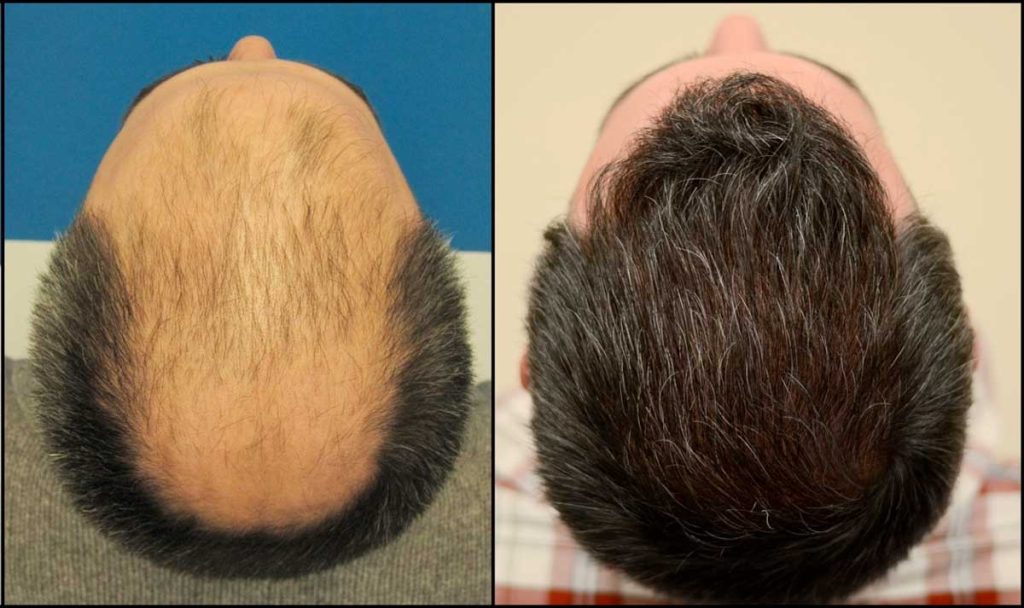
How Many Grafts Are Needed for Hair Transplantation for Crown Thinning?
A large number of individuals experiencing hair loss first notice the receding hairline when they look in the mirror. However, the most insidious and challenging area to cover for hair loss is the crown area, referred to as the “Vertex” in medical literature. This thinning area, usually noticed in barber chairs, elevator mirrors, or photos taken from behind, has completely different dynamics from the front area in terms of surgical planning. The answer to the questions most frequently asked by patients, such as “When will my crown area close?” or “How many grafts should be transplanted there?”, requires much more than a simple mathematical calculation; it requires a deep anatomical analysis.
The Anatomical Challenge of the Vertex Area: Why More Hair is Needed?
In hair transplantation surgery, the crown area is often described as a “black hole” among surgeons. The reason for this analogy is that this area has a very high capacity to swallow grafts. While the front hairline is a straight line and the hairs overlap, creating a “wall effect” when viewed from the front, the crown area has a spherical structure. The hairs in this area open outwards in a spiral shape from a center called a “whorl.”
This spiral structure causes light to hit the scalp at a right angle, making the skin more visible. While the illusion of “fullness” can be created with fewer grafts in the front area, a much higher density of grafts is needed to achieve the same coverage in the crown area. Therefore, when calculating grafts for crown baldness, the density coefficient multiplied by the area in square centimeters should always be higher than for the front area.
Critical Variables Determining Graft Number
Each patient’s head structure, baldness ratio, and donor capacity are as unique as a fingerprint. Therefore, making a generalization such as “3000 grafts are transplanted to the crown area” is not medically accurate. The main factors determining the number of grafts needed are:
- Width of the Gap (Norwood Scale): Is it just a small circle, or a large area extending from the crown to the front? The size of the area in square centimeters directly determines the number of grafts.
- Hair Strand Thickness (Caliber): In individuals with thick hair strands, more coverage can be achieved with fewer grafts. In fine hair, denser implantation is necessary to prevent the skin from showing.
- Skin and Hair Color Contrast: In individuals with light skin and light hair, even sparse implantations can appear fuller because the color difference between the scalp and hair is small. However, in individuals with dark hair and light skin, more grafts are needed because the contrast is high.
- Donor Area Capacity: The reserve in the nape area is not unlimited. The surgeon cannot neglect the front hairline while trying to cover the crown. Strategic allocation of the existing reserve is vital.
Estimated Graft Calculation
The table below shows the average number of grafts needed in the crown area according to different degrees of baldness. These figures are a general reference range, and the exact numbers can only be determined after a detailed hair analysis and planning.
| Depth Status | Description | Estimated Graft Spacing | Operational Strategy |
|---|---|---|---|
| Mild Epoch | Thinning only in the vertex center, about the size of a coin. | 800 – 1500 Grafts | Touch-up (densification) by inserting grafts between existing hairs. |
| Moderate Epoch | Hair loss the size of a palm, where the skin is clearly visible. | 1500 – 2500 Graft | Dense transplantation performed while preserving the spiral structure. |
| Advanced Baldness | Large area spreading from the crown to the nape and forward. | 2500 – 4000+ Grafts | Two-session planning may be necessary (First the front, then the crown). |
| Complete Baldness (Norwood 6-7) | No bridge remains between the donor area and the crown. | Combined Planning | Donor area may be insufficient, beard-supported transplantation may be necessary. |
Success in Crown Transplantation: Density or Coverage?
Crown In hair transplants in the crown area, patients generally expect to return to the hair density they had during adolescence. However, the primary goal in surgery is not “full density,” but “cosmetic coverage.” The human eye does not perceive baldness until 50% of hair density is lost. Therefore, the surgeon’s goal is to achieve full coverage, not just the crown area.The goal is to reduce the reflection of light on the skin by increasing the density in the area to 40-50%.
If the donor area is limited, surgeons usually apply the “Front Area Priority” principle. This is because in social interaction, people look at the face, and the front profile is more aesthetically valuable. The remaining grafts for the crown area are used to create a “blurred” appearance, even if they don’t provide complete coverage, to reduce the noticeable appearance of baldness.
Why is the Likelihood of a Second Session High?
In patients with a large crown area, trying to cover the entire baldness in a single session can lead to excessive thinning in the donor area or failure of the transplanted roots to take root due to insufficient nutrition (risk of necrosis). Therefore, in Norwood 5 and higher baldness, the professional approach is to divide the operation into two stages.
In the first session, the front and midline are created, and a slight transition is made to the crown area. Approximately one year later, when blood circulation has returned to normal and the donor area has recovered, a second tightening session focusing only on the crown is planned. This strategy both protects the health of the donor area and maximizes the survival rate of the grafts.
Result: Realistic Expectations, Happy Results
Hair transplantation for crown baldness is a process that requires patience and proper planning. The answer to the question, “Will my crown be completely covered with 2000 grafts?” lies in your head shape and hair quality. High graft numbers do not always mean better results; what is important is that the existing grafts are placed at the correct angles, mimicking the natural spiral structure.
Hair transplantation is a restoration process. It ensures the cosmetic camouflage of the baldness by using existing resources in the most efficient way. With a detailed consultation with an expert physician, computerized hair analysis, and realistic planning, crown baldness can be covered to a level that will restore the person’s self-confidence.