
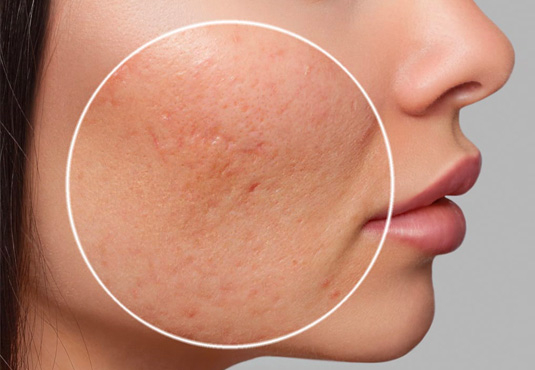
Acne Scar Treatment
Acne is a chronic inflammatory condition of the hair follicle and sebaceous gland unit, called the pilosebaceous unit, that many individuals experience from adolescence to adulthood. However, the scars left on the skin surface after the active phase of acne ends can become a skin health problem with psychosocial effects beyond aesthetic concerns for individuals. As Private Demiderm Polyclinic serving in Izmir, we address the management of acne scars and skin restructuring processes with a medical discipline within the framework of dermatological applications and medical aesthetic procedures.
What are Acne Scars?
Acne scars are a result of the body’s natural healing response to severe acne formation and tissue damage in that area. When acne lesions create inflammation under the skin, the follicle wall can rupture. If this rupture is close to the surface, healing is usually rapid and no scar remains. However, if the rupture in the follicle wall penetrates into the deep dermis layer, the infected material spreads to the surrounding tissue, causing greater tissue damage.
The body sends collagen fibers to the area to repair this damage. However, this repair process cannot always perfectly replicate the skin’s original, smooth structure. Sometimes the body produces too little collagen, leading to depressions in the skin (atrophic scars); sometimes it produces too much collagen, resulting in raised scars (hypertrophic or keloid scars). Therefore, an acne scar is a permanent change in the fibrous structure of the dermis layer of the skin. These scars are not just superficial color changes (post-inflammatory hyperpigmentation), but structural abnormalities characterized by tissue loss or excess tissue. Why Do Acne Scars Form?
The mechanism of acne scar formation is directly related to the skin’s response to inflammation. Not every pimple leaves a scar; However, deep, painful, and purulent acne in the form of nodules or cysts has the highest risk of scarring. The causes can be primarily attributed to the following factors:
**Severity of Inflammation:** The more intense and deep the inflammation under the skin, the greater the tissue damage. Significant damage leads to disruption of the skin’s architecture during the healing process.
**Delayed Intervention or Incorrect Treatments:** Squeezing, popping, or traumatizing acne causes the follicle wall to break down and inflammation to spread to deeper tissues. This complicates the healing process and increases the risk of permanent damage.
**Genetic Predisposition:** Some individuals have a genetically predisposition to scarring. Individuals with a family history of severe acne scarring may have a higher risk.
**Genetic Predisposition:** Collagen Production Imbalance: The production of insufficient or excessive collagen by fibroblasts, the skin’s repair mechanism during the healing process, is the main factor determining the type and depth of the scar.
What are the Types of Acne Scars?
Acne scars are not uniform, and the type of scar is vital in determining the treatment protocol. In general, acne scars are examined in two main categories: those due to tissue loss (Atrophic) and those due to excess tissue (Hypertrophic/Keloid). Atrophic scars are the most common type.
How Many Types of Acne Scars Are There?
In clinical practice, the most common atrophic acne scars are grouped under three main headings. Each has a different depth, shape, and response to treatment.
Ice Pick Scars: As the name suggests, these scars appear as if a thin ice pick or needle has been inserted into the skin. They are less than 2 mm in diameter but can penetrate deep into the dermis or subcutaneous tissue. They have a “V” shape. Although they appear small from the surface, they are one of the scar types that require the most patience to treat due to their depth.
Boxcar Scars: These are sharp-edged, box-like, wide-based depressions. Their diameter usually ranges from 1.5 to 4 mm. They can be deep or superficial. They resemble chickenpox scars. They exhibit a “U” shape and are usually seen on the temples or cheeks.
Rolling Scars: These are depressions with soft and indistinct edges that give the skin a wavy appearance. They are formed as a result of fibrous bands (fibrotic bands) pulling the skin downwards. They can be 4-5 mm or wider in diameter. They make the overall texture of the skin appear uneven.
In addition to these, there are also hypertrophic and keloid scars that are raised from the skin surface. These scars are generally more common in body areas (back, chest), but can also occur on the jawline.
Differences Between Acne Scars and Blemishes
| Features | Acne Scar (Scar) | Acne Blemish (Hyperpigmentation/Erythema) |
|---|---|---|
| Tissue Structure | There is pitting or raising on the skin surface. It is a physical tissue disorder. | Skin yThe surface is smooth, only discoloration is present. |
| Cause of Formation | Collagen damage or abnormal collagen production. | Increased melanin or vasodilation after inflammation. |
| Persistence | If left untreated, it can last a lifetime. | It may fade spontaneously over time, but the process is slow. |
| Treatment Approach | Restructuring treatments such as laser, radiofrequency, and subcision are required. | Chemical peeling, topical creams, and laser toning are preferred. |
Who Gets Acne Scars?
What Happens If Acne Scars Are Not Treated?
While acne scars are a potential risk for anyone with active acne, their incidence is higher in certain groups. Individuals with nodulocystic acne (deep cysts and nodules) are much more likely to scar than those with superficial acne. Scar formation is frequently observed in those who experienced severe acne during adolescence, in cases where treatment was started late, and in individuals who have a habit of physically picking at their pimples (squeezing, scratching). Genetic factors also play an important role; individuals with a family history of acne scars may be more prone to scarring due to their response to inflammation at the cellular level.
From a medical perspective, acne scars do not pose a life-threatening risk or develop into a systemic disease. However, if left untreated, existing scars do not disappear on their own and become permanent. As we age, the skin’s natural collagen production decreases and it loses elasticity, causing existing scars to become more prominent. Atrophic (pitted) scars, in particular, can appear deeper with sagging skin tissue. Psychologically, untreated scars can affect individuals’ self-confidence, social relationships, and overall quality of life.
How are Acne and Pimple Scars Treated?
Treating acne scars is not a simple process that can be solved with a single method. The treatment plan is created individually for each patient by the physicians at Özel Demiderm Polyclinic, taking into account the patient’s skin type, the depth of the scars, the type of scar (ice pick, rolling, boxcar), and the patient’s social life (tolerance for healing time). The main goal is to stimulate the damaged tissue in a controlled manner and trigger the skin’s self-repair mechanism (remization) to ensure the production of new collagen.
Acne Scar Treatment Methods
In the field of modern medical aesthetics and dermatology, there are many different technologies and methods used to lighten the appearance of acne scars.
Fractional Laser Applications
Fractional lasers (e.g., CO2 or Erbium lasers) are one of the powerful methods frequently used in acne scar treatment. This technology creates thermal damage zones in microscopic columns instead of damaging the entire skin. The tissues that remain intact allow the damaged areas to heal quickly. In this process, strong collagen stimulation occurs and the skin surface is renewed. It can be preferred especially in deep boxcar and rolling scars.
Gold Needle Radiofrequency (Fractional Radiofrequency)
Gold needle treatment is based on the principle of transmitting radiofrequency energy to the dermis layer of the skin through micro-needles. The needles penetrate directly to the targeted depth without damaging the surface of the skin and emit heat energy there. This heat shortens collagen fibers and triggers new collagen production. Because it doesn’t cause peeling on the skin’s surface, the healing time may be shorter compared to lasers, and its applicability can be considered in the summer months (provided sun protection is used).
Subcision
It is particularly effective in “rolling” type scars where fibrotic bands pull the skin down. Under local anesthesia, a special needle tip is inserted under the skin, and the ligaments pulling the skin down are released. In this way, the depression is freed and rises over time. This procedure is usually combined with other methods.
Chemical Peeling
This is a preferred method for superficial scars and blemishes. Acid solutions (TCA, Glycolic acid, etc.) are used to provide controlled peeling of the upper layer of skin. The aim is to reveal fresher and smoother skin underneath. In deep scars, the method of applying a high concentration of acid only into the scar (TCA CROSS) can also be used.
Dermapen and Microneedling
This method initiates the skin’s repair mechanism by creating numerous micro-channels on the skin’s surface. Solutions containing vitamins, minerals, or hyaluronic acid can also be applied through these channels, depending on the skin’s needs. It is a helpful method for superficial scars and pore tightening.
Injection Methods and Filler Applications
In some deep and wide sunken scars, hyaluronic acid-based fillers can be used to fill the skin underneath and equalize the level difference. While this is not a permanent solution, it provides immediate relief.It provides cosmetic correction and can also partially support the skin’s collagen production over time. Why are Combined Treatments Preferred for Deep and Pitted Acne Scars?
Most patients do not have a single type of acne scar; usually a combination of ice pick, boxcar, and rolling scars is seen. Therefore, a single device or method may not provide the same success in all scar types. For example, while the ligaments holding the skin together are broken with subcision, the skin surface and quality can be improved with laser or gold needle in the same session or in subsequent sessions. In the protocols applied at Özel Demiderm Polyclinic, combined treatments (multimodal approach) are planned according to the patient’s needs, aiming to intervene in different layers of the skin simultaneously or gradually. This approach aims to increase the effectiveness of the treatment. How Many Sessions Does Acne Scar Treatment Take?
The duration of acne scar treatment varies greatly depending on the depth and extent of the scars and the method used. It is medically impossible for scars to completely disappear in a single session. The skin’s collagen production and regeneration is a biological process that takes time. Protocols are usually applied that vary between 3 and 6 sessions depending on the method. Session intervals are planned between 3-4 weeks, depending on the skin’s healing rate. The full effect of the treatment is more clearly observed in the 3-6 month period after the last session, once collagen production is complete.
How Does the Treatment Process Work?
Consultation and Analysis: In the first step, the physician performs a skin analysis to determine the type and depth of the scars. The patient’s medical history and medications used (for example, if isotretinoin is used, the treatment timing is adjusted accordingly) are evaluated.
Planning: A personalized treatment plan is created. The order in which each method will be applied is determined.
Application: On the day of the procedure, the area to be treated is cleaned, and local anesthetic creams are applied for the patient’s comfort. The chosen treatment method is applied under hygienic conditions.
Healing: Redness, mild swelling, or crusting (depending on the method) may occur on the skin after the procedure. Use the care creams and sunscreens recommended by your doctor.
What to Pay Attention to After Acne Scar Treatment
One of the most important factors affecting treatment success is post-treatment care. Patients undergoing treatment in a location like Izmir, which has many sunny days, should pay particular attention to the following:
Sun Protection: The treated skin is sensitive to the sun. High-factor (SPF 50+) sunscreen should be used, and direct sun exposure should be avoided. Otherwise, the risk of developing spots (hyperpigmentation) increases.
Hygiene: The skin should be kept clean, and products other than the cleansers recommended by your doctor should not be used to prevent infection.
Avoiding Scabs: If scabs form after procedures like fractional laser treatment, they should absolutely not be removed; they should be allowed to fall off naturally.
Moisturizing: To support the skin’s repair process, the restorative and moisturizing creams recommended by your doctor should be applied regularly.
Makeup: It may be recommended to avoid makeup for a certain period (usually 24-48 hours) after the procedure.
Avoiding Heat: For the first few days, excessively hot environments such as Turkish baths, saunas, and hot showers should be avoided.
Factors Affecting Healing Time in Acne Scar Treatment
Each individual’s healing process is unique, and there are various variables that affect this process:
Age: Since cell renewal and collagen production are faster in younger skin, the healing process may be faster than in older age groups.
Nutrition and Water Intake: A diet rich in protein, vitamins (especially vitamin C), and minerals, along with ample water intake, supports the skin’s repair mechanisms.
Smoking: Smoking slows blood circulation, impairing skin oxygenation. This delays wound healing and can negatively affect the response to treatment.
Genetic Structure: An individual’s wound healing rate (predisposition to scar formation or rapid healing) depends on genetic factors.
Depth of Treatment: Aggressive laser treatments have a longer recovery time (return to social life) compared to more superficial applications.
How is Acne Scar Treatment Personalized According to Skin Type?
Skin type (according to the Fitzpatrick scale) is a determining factor in the safety and effectiveness of treatment. Some laser wavelengths used on light-skinned individuals may carry a risk of leaving marks on dark-skinned individuals. Therefore, radiofrequency technologies (gold needle) or laser systems with a lower risk of discoloration are generally preferred in patients with dark skin. Additionally, whether the skin is oily, dry, or combination also affects the choice of post-treatment skincare products.Demiderm Private Polyclinic takes care to determine the safest treatment parameters by analyzing each patient’s skin phototype.
What Results Should Those with Acne Scars Expect from Treatment?
Having realistic expectations in acne scar treatment is critical for patient satisfaction. With current medical technologies, a very significant improvement in the appearance of scars can be achieved, their depth can be reduced, and the overall texture of the skin can be made much smoother. However, it may not be biologically possible in most cases for the skin to completely transform into 100% smooth, baby-soft skin, as if “never had acne.” The goal is to reduce the visibility of scars to a level that is not noticeable from a social distance and to improve the person’s skin quality. The results each patient receives will vary depending on the severity of the scars and the biological response of the skin to the treatment.
Can Acne Scars Be Prevented?
The most effective way to prevent acne scars is to receive the right treatment during active acne periods.
Avoid picking at or squeezing acne.
Seek medical attention immediately for inflamed acne.
Apply the treatments (topical or systemic) prescribed by your doctor regularly.
Protect yourself from the sun (Sunlight darkens the color of healing acne lesions, increasing the risk of scarring).
Common Misconceptions About Acne Scar Treatment
Some information spread by word of mouth can negatively affect the treatment process.
False: “Acne scars will completely disappear on their own over time.”
True: Only superficial spots may fade over time, but pitted (atrophic) scars will not improve without treatment.
False: “Applying lemon, vinegar, or toothpaste will remove scars.”
True: Such acidic or irritating substances can burn the skin, leave marks, and worsen the condition.
False: “Acne scar treatment cannot be done in the summer.”
True: While some laser treatments are not preferred in the summer, methods like gold needle treatment can be applied in the summer months as long as sun protection is taken into consideration.
False: “It is possible to get rid of all scars in a single session.”
True: Acne scar treatment is a process and requires multiple sessions.