
Filler Applications in Izmir
The human face is like an anatomical map that most clearly reflects the effects of time. In youth, the fat pads densely located in the lower layers of the skin, strong bone structure, and high collagen production give the face that characteristic “inverted triangle” (V-shape) form. However, with the aging process, gravity, sun damage, and hormonal changes, this dynamic structure begins to change. Resorption (melting) occurs in the bone tissue, and volume loss and displacement occur in the fat pads. This leads to sagging, deepening shadows, and a tired expression on the face. In the field of modern medical aesthetics, one of the most important instruments aimed at replacing these losses and rebalancing facial features without the need for surgical intervention is “Dermal Filler” applications.
At Izmir Private Demiderm Polyclinic, we treat filler applications not as a simple “inflation” procedure, but as a “restoration” and “architectural planning” process. We adopt an approach that respects the anatomical proportions of the face, replacing what is missing or correcting asymmetries without disrupting natural expression. In this comprehensive guide, we will examine all the details you might be curious about, from the chemistry of fillers to application techniques, from area-based anatomical assessments to healing processes, in light of scientific data.
What are Filler Applications?
Dermal filler applications are the process of injecting biocompatible gel-like substances into the dermis layer of the skin or onto the bone membrane (supraperiosteal). This procedure is primarily performed to address volume loss, fill deep wrinkles, define facial features (contouring), and provide moisture (hydration) to the skin. Today, the most commonly used filler is Hyaluronic Acid (HA) based products; however, collagen-stimulating fillers such as Calcium Hydroxyapatite or Poly-L-Lactic Acid are also used in certain indications.
What are Filler Treatments Used For?
Filler applications are used for a wide range of aesthetic and reconstructive purposes:
- Volume Restoration: Eliminating depressions in the temples, cheeks, and mid-face that occur with age.
- Projection (Forward Lifting): Defining a receding chin or raising the cheekbones.
- Asymmetry Correction: Balancing differences between the right and left halves of the face, whether congenital or acquired.
- Hydration and Skin Quality: Increasing the skin’s moisture retention capacity to make it look more vibrant.
- Profiloplasty: Bringing the relationship between the forehead, nose, lips, and chin to ideal proportions in terms of profile.
- Scar Treatment: Treating deep acne scars or other scars. Filling the skin with gold and bringing it to the skin level.
How Do Hyaluronic Acid Fillers Work?
Hyaluronic acid (HA) is a polysaccharide (sugar chain) that occurs naturally in the human body and is found in the structure of the skin, joints, and eyes. Its most basic feature is that it is “hydrophilic”; that is, it has the capacity to retain up to 1000 times its own weight in water. Synthetic HA fillers, produced in a laboratory environment through bacterial fermentation, are processed with “cross-link” technology. This technology prevents the hyaluronic acid from being immediately metabolized by the body, increasing its permanence and bringing it to a gel form. When injected into the skin, it both physically creates volume and retains water, ensuring the hydration and firmness of the tissue.
Filler Application Process
At Izmir Private Demiderm Polyclinic, the filler procedure is managed in accordance with medical standards with the following stages:
1. Anatomical Assessment and Planning: Before the procedure, the patient’s facial anatomy, expressions, and volume loss are analyzed in detail. The patient’s expectations are aligned with medical realities.
2. Preparation and Anesthesia: The application area is cleaned with antiseptic solutions. Strong local anesthetic creams are applied to ensure comfort during the procedure. Some fillers also contain lidocaine (an anesthetic).
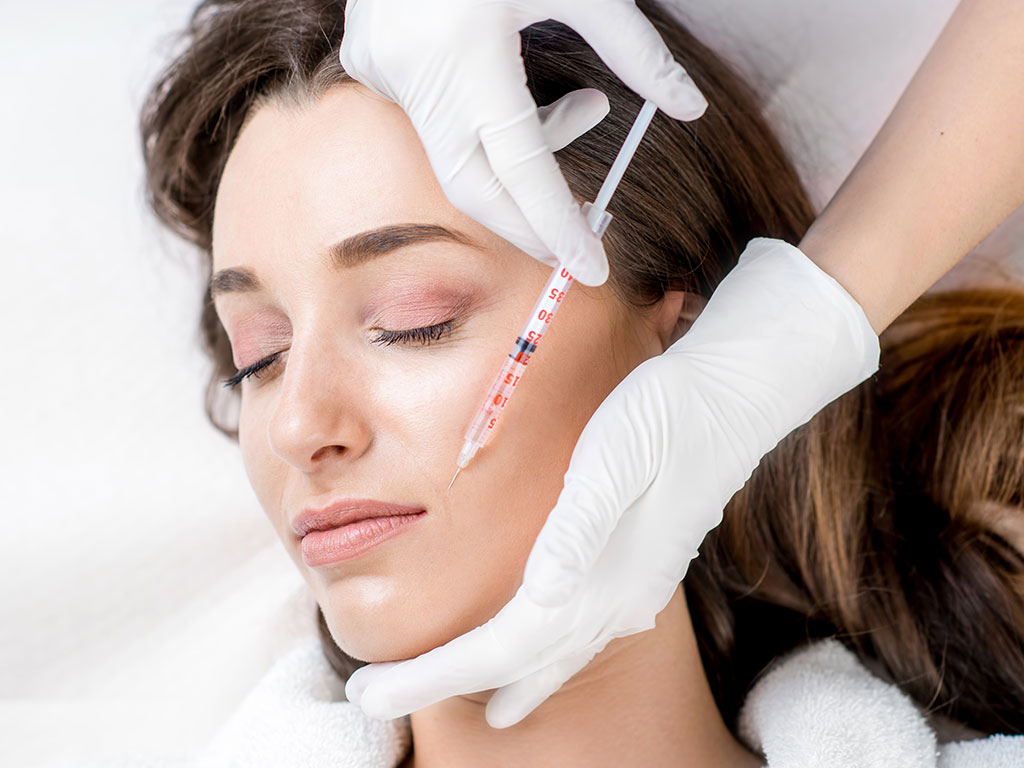
3. Injection: Depending on the characteristics of the area to be treated, the physician chooses to use fine-tipped needles or blunt-tipped cannulas (devices that reduce the risk of trauma). The filler is slowly injected to the planned depth.
4. Massage and Shaping: After the injection, the physician gently massages the area to ensure the filler integrates with the tissue and is evenly distributed, giving it its final shape.
Who Can Get Fillers?
Individuals who are 18 years of age or older, in good general health, and not pregnant or breastfeeding can get fillers. However, the procedure is not performed on areas with active skin infections (herpes, acne, etc.), those with uncontrolled autoimmune diseases, or those with a known allergy to the filler material. The physician will check the medical history before the procedure.It is essential to apply it.
Benefits of Filler Applications
- Provides immediate results (the final form settles after the swelling subsides).
- The recovery process is much shorter compared to surgery.
- Does not carry the risk of general anesthesia.
- It is a reversible procedure (the filler can be dissolved with the hyaluronidase enzyme).
- Softens facial expressions and provides a more youthful appearance.
- Has effects that stimulate natural collagen production.
Types and Areas of Fillers Applied to the Face
Each area of the face has a different tissue thickness, vascular structure, and mobility. Therefore, fillers of different densities (viscosities) and elasticities (G-prime) are used for each area.
Lip Fillers and Shaping
The lips are the center of facial aesthetics. Lip fillers are not only used to add volume; they are also used to correct asymmetries, define the lip contour (vermilion line), clarify the Cupid’s bow (the M shape above the lip), and tighten sagging around the lips. “Russian Lips” or natural volume techniques are chosen according to the patient’s facial proportions.
Profile Balancing with Chin Filler (Jawline)
In individuals with a receding chin (retrognathia), the facial profile appears unbalanced, and the double chin problem becomes more pronounced. Firm fillers applied to the chin provide projection, strengthening the facial profile. “Jawline” filler, applied along the jawline, sharpens the facial oval and makes it look more characteristic.
Non-Surgical Nose Aesthetics with Nose Filler
This is an option for patients who do not want or are not suitable for surgical rhinoplasty. It is used to camouflage the hump on the bridge of the nose, slightly lift the tip of the nose, or correct depressions at the base of the nose. Because nasal anatomy is complex from a vascular perspective, this procedure requires a high level of expertise.
Cheek Fillers for Facial Volume Enhancement
The first signs of aging usually begin in the mid-face. The fat pads in the cheeks melt and sag. Deep filler applications to the cheekbones lift the face like a sling (lifting effect). This both plumps the cheeks and reduces the grooves at the sides of the nose (nasolabial folds).
Nasolabial Fillers (Smile Lines)
The grooves that run from the nostrils to the corners of the lips are called nasolabial sulci. Deepening of these lines causes a tired expression. Fillers in this area reduce shadowing. However, if the main cause is sagging cheeks, first performing a lifting with cheek fillers gives a more natural result.
Under-Eye Light Filler
It is applied for under-eye hollowing and the resulting dark circles (shadow effect). Fillers specifically formulated for this area, with balanced water retention capacity and containing vitamins and minerals, are used. It corrects the “tear trough” deformity, making the person look more rested.
Post-Filler Recovery Process
Filler applications are among the procedures that “do not affect social life.” However, since a material occupying space within the tissue is injected, some processes are normal:
- Edema: Mild swelling is expected for the first 2-3 days. Swelling may be slightly more pronounced in mucous membrane areas such as the lips.
- Bruising: Small bruises may occur at the injection sites, which can be covered with makeup and will disappear within 3-7 days.
Sensation: You may feel hardness or fullness in the area where the filler was injected in the first few days; As the filler integrates with the tissue (approximately 2 weeks), this sensation disappears and the tissue softens.
Points to Consider Before and After Filler Treatment
Before and After Filler Treatment
Before the Procedure:
Blood-thinning medications (with doctor’s approval) should be discontinued 3-5 days before the procedure.
Alcohol consumption should be stopped 1-2 days beforehand as it increases the risk of edema.
After the Procedure:
Make-up and avoid applying makeup to the application area for the first 24 hours.
Avoid excessively hot environments such as Turkish baths, saunas, and hot showers for the first 3 days (heat increases edema).
Drinking plenty of water helps hyaluronic acid retain water and maintain its form.
- Harsh massage should not be applied to the application area.
How Long Do Filler Applications Last?
The duration of filler application varies from person to person and from area to area. Factors affecting this duration include:
Metabolism Rate: The faster a person’s metabolism, the faster the filler can be absorbed.
Mobility of the Area: Fillers dissolve faster in very mobile areas such as the lips (on average 6-12 months), while they can last longer (12-18 months) in immobile areas such as the temples or under the eyes.
Characteristics of the Filler Material: Thick (high G-prime) fillers are longer-lasting than thin fillers.
Small touch-ups at regular intervals extend the duration of application.
Materials Used in Filler Applications
In our clinic, sOnly products from brands approved by the Ministry of Health, CE certified, and whose reliability has been proven by clinical studies are used. While the most commonly used material is Hyaluronic Acid, mineral-based fillers such as Calcium Hydroxyapatite (Smart Filler) can also be preferred in cases where longer-lasting results and collagen stimulation are desired. Your doctor will choose the material most suitable for your skin type.
Mechanism of Rejuvenation with Fillers
Fillers do not only perform a physical “filling” process. Research shows that hyaluronic acid stretched under the skin stimulates fibroblasts through a mechanical stretching effect and triggers the skin to produce its own collagen. Therefore, even when the filler dissolves, the skin may remain in better condition than before the procedure.
Is Filler a Painful Procedure?
Modern filler injectors are quite thin. Furthermore, thanks to the local anesthetic creams applied before the procedure and the lidocaine contained in the filler, comfort during the procedure is maximized. Patients usually experience a slight stinging and pressure sensation, but this is tolerable.
Side Effects and Safety in Filler Applications
Filler applications are safe when performed by skilled hands (physicians). However, there are risks of complications, albeit rare:
- Infection (if hygiene rules are not followed).
- Clumping or asymmetry.
- Intravenous injection (Vascular occlusion): This is the most serious complication. Therefore, it is vital that it is performed by physicians who are familiar with anatomy. The biggest advantage of hyaluronic acid fillers is that they can be instantly dissolved with the “Hyaluronidase” enzyme in case of a possible problem.
What Happens When the Filler Dissolves?
The filler material is metabolized by the body over time (converted into water and carbon dioxide) and excreted. When the filler dissolves, the skin does not suddenly sag or worsen. On the contrary, thanks to the moisture and collagen support it provides to the skin during the procedure, the skin quality may be in better condition than before the procedure. The face gradually returns to its former shape.
Filler or Botox? Which is Preferred in Which Situation?
These two procedures are often confused, but their mechanisms of action are completely different.
| Features | Botox (Botulinum Toxin) | Dermal Filler |
|---|---|---|
| Mechanism of Action | Temporarily relaxes muscles. | Adds volume and fills gaps. |
| Purpose of Use | Dynamic wrinkles (expression lines). | Static wrinkles (established lines) and volume loss. |
| Application Areas | Forehead, between eyebrows, around the eyes (eyelids) feet). | Lips, cheeks, chin, nasolabial folds, under-eyes. |
| Result Duration | Effect begins in 3-7 days, settles in 14 days. | Result is seen immediately, becomes clear when swelling subsides. |
| Permanence | Average 3-6 months. | Average 6-18 months. |
When Will Filler Application Results Be Seen?
The volume effect is seen immediately after filler injection. However, due to swelling caused by the procedure trauma, the initial appearance is not the final result. It takes an average of 10-14 days for the swelling to subside, for the filler to integrate with the tissue by retaining water, and for it to soften. A touch-up (control) procedure can be performed at the end of this period if necessary.
Filler Applications in Izmir and the Demiderm Approach
At Izmir Private Demiderm Polyclinic, filler applications are performed with the principle of preserving facial harmony. Avoiding the appearance of “overfilled syndrome,” the goal is to reveal the person’s natural beauty, resulting in a fresh and rested expression. The barcode and contents of each material used are shared transparently with the patient. Beyond being an aesthetic procedure, it is approached with the awareness that this is a medical procedure.