
Izmir DHI Hair Transplantation
Hair loss (alopecia) is an aesthetic and psychosocial condition that can occur in both men and women, triggered by genetic predisposition, hormonal changes, or environmental factors. Techniques developed in hair restoration surgery in recent years aim to minimize tissue trauma and maximize graft (hair follicle) viability. DHI (Direct Hair Implantation), which is at the forefront of these techniques, is a method that takes hair transplantation procedures a step further, requiring precision and technical skill. As Izmir Private Demiderm Polyclinic, we approach hair health and restoration processes with a medical discipline. In this comprehensive guide, we will examine all the details of the DHI technique, from its working principles to healing processes, from donor area management to graft calculation, in the light of scientific data.
What is DHI Hair Transplantation?
DHI (Direct Hair Implantation), translated into Turkish as “Doğrudan Saç Ekimi” (Direct Hair Transplantation), is a specialized form of the FUE (Follicular Unit Extraction) method in the implantation phase. While hair transplantation in traditional methods is performed in two separate stages (channel opening and root placement), in the DHI technique, these two stages are performed in a single step thanks to special medical pens called “Choi Implanter Pens”.
In this method, hair follicles taken from the donor area are simultaneously placed under the skin while the tip of the pen is inserted into the skin, without opening any preliminary channels (incisions). This technique aims to increase the viability rate of grafts by shortening the waiting time of the hair follicles in the external environment and to minimize the risk of bleeding in the transplantation area. DHI is a preferred method, especially in cases requiring precision such as hair thickening transplants (transplantation between existing hairs) and hairline design.
How is the DHI Technique Applied?
The DHI procedure is a process that requires microsurgical precision and usually involves the coordinated work of multiple specialists. The procedure basically works on the following principle:
- Grafts collected from the donor area (usually the nape of the neck) with the help of micromotors are kept in special solutions.
- These grafts are carefully placed one by one into hollow, needle-equipped pens called “Choi Pens”.
- The specialist physician or practitioner brings the pen close to the scalp at a specific angle (usually 40-45 degrees).
- When the needle tip pierces the skin and reaches the dermis layer, the graft is released into the graft socket by pressing the piston mechanism at the back of the pen.
- This process is repeated thousands of times until the planned number of grafts is completed.
What is a Choi Pen and How Does it Work?
The Choi Pen is a medical device that forms the heart of the DHI technique. Originally developed in South Korea, this instrument features a fine-tipped needle (with diameters ranging from 0.6mm to 1.0mm) and a mechanism that pushes the hair follicle placed inside the needle. The pen’s structure is as follows:
- Hollow Needle: This is the part where the hair follicle is placed and enters the skin. Different diameter needles are used depending on the thickness of the hair.
- Channel: This is the section that securely holds the graft in place.
- Piston (Pusher): Located at the top of the mechanism. When pressed, it pushes the hair follicle inside the needle under the skin.
The use of these pens eliminates the channel opening (slit) stage, resulting in less trauma to the skin.
Differences Between DHI and FUE
Both methods use the FUE (Follicular Unit Extraction) principle in the follicle harvesting stage. The difference becomes apparent during the root transplantation (implantation) stage.
It is possible.It is minimal, clotting is rapid.
It is minimal; clotting is rapid.
| Features | Classic FUE Method | DHI (Choi Pen) Method |
|---|---|---|
| Channel Opening | First, channels (slits) are opened, then the roots are placed. | Channel opening and implantation are done simultaneously. |
| Shaving Requirement | Generally, the transplantation area needs to be shaved. | Unshaved transplantation (only donor area shaving) is possible. |
| Amount of Bleeding | Slight leakage due to channel opening. | |
| Planting Density | A certain density can be reached (40-50 grafts/cm²). | Higher density can be achieved (60-80 grafts/cm²). |
| Duration | It can be completed in a shorter time. | It is a longer and more labor-intensive process. |
| Graft Waiting Time | The roots wait outside during channel opening. | Since the roots are planted immediately after being collected, the time It is short. |
Advantages of DHI Hair Transplantation
The main reasons for choosing the DHI technique are its preservation of tissue integrity and the naturalness of aesthetic results:
- Possibility of Denser Transplantation: Because the pen tips are very thin, the roots are very close to each otherThey can be planted at close distances. This provides a denser and fuller hair appearance.
- Direction and Angle Control: The direction and angle of hair growth can be precisely determined by the position of the pen. This prevents a “grass man” appearance, and the hair grows in its natural direction.
- Fast Healing: Since no channels are opened, the amount of incision in the skin is minimal. The crusting and healing process is faster compared to classical methods.
- Preservation of Existing Hair: DHI minimizes the risk of damaging existing hair follicles in transplants (tightening) performed by inserting grafts between existing hairs.
Who is DHI Hair Transplant Suitable For?
The DHI method is suitable for many candidates considering hair transplantation, but it is especially recommended in some cases:
- Frontal Hairline Transplants: In frontal area transplants where naturalness is most critical.
- Those Who Want a Shave-Free Hair Transplant: Ideal especially for women or men who do not want to cut their hair.
- Thinning Correction (Tightening): Those who want to transplant hair to areas that have not completely lost their hair but have thinned, without damaging existing hair.
- Those with Insufficient Donor Area: The roots Situations where hair needs to be used with maximum efficiency without being wasted.
DHI Hair Transplantation Stages
The DHI process applied at Izmir Private Demiderm Polyclinic consists of the following steps:
1. Consultation and Planning: Hair analysis is performed, donor area capacity is measured, and the front hairline design is created.
2. Local Anesthesia: Both the donor and the recipient area are numbed with local anesthesia. The patient is conscious during the procedure but does not feel pain.
3. Graft Harvesting (Extraction): Hair follicles are collected and separated one by one from the donor area using the FUE method.
4. Placement in Pens: The collected follicles are carefully placed into Choi pens by assisting healthcare personnel. This stage requires teamwork.
5. Implantation (Transplantation): The physician uses pens to transplant hair follicles into the skin at the determined angle and direction.
DHI Hair Transplantation Preparation
There are rules the patient must follow for a successful operation:
- Blood-thinning medications (aspirin, etc.) should be discontinued at least 1 week before the operation under the doctor’s supervision.
- Alcohol and smoking should be stopped 1 week before the procedure as they negatively affect tissue healing and blood circulation.
- Caffeinated beverages should not be consumed on the day of the operation.
- Comfortable clothing with front buttons or zippers should be worn on the day of the operation (to prevent friction against the head when putting it on and taking it off).
DHI Hair Transplantation Post-Care
The post-transplantation process is at least as important as the transplantation procedure itself. The first 10 days are critical for the newly transplanted follicles to take root.
- The first 3 days of home rest are recommended.
- To prevent swelling of the head, the head should be kept elevated while sleeping and one should lie on their back.
- The transplanted area should be protected from all kinds of impacts, friction, and sunlight.
- Medications prescribed by the doctor (antibiotics, painkillers, anti-inflammatory drugs) should be used regularly.
DHI Hair Transplant Post-Washing Rules
The first wash is usually performed at the clinic where the procedure was done, on the 2nd or 3rd day. Subsequent washes should be done at home as follows:
- The softening lotion recommended by the doctor is gently applied to the transplant area and left for 30-45 minutes to soften the scabs.
- Gently rinse the lotion with lukewarm water.
- The special medical shampoo is lathered in the palm of the hand and applied to the transplant area with “dampening” movements (without rubbing).
- Rinsing is done with low-pressure water.
- This routine continues until the scabs fall off (approximately 10-12 days).
DHI Hair Transplant Post-Recovery and Scab Formation Process
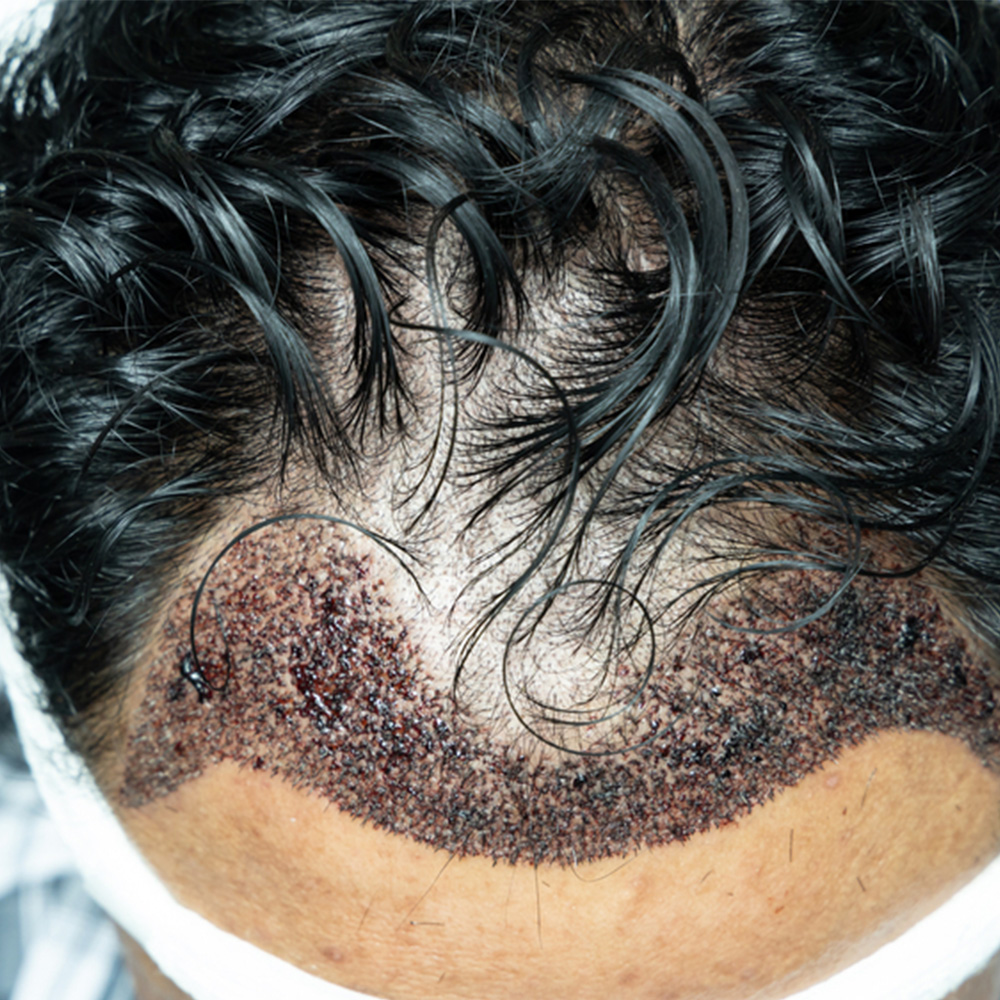
In the days following the procedure, small, pinpoint scabs will form in the transplant area. This is a natural part of the skin’s healing process. With regular washing, these scabs will completely fall off by the 10th day. With the shedding of the scabs, the scalp will have a clean and healed appearance.
Shock Shedding After DHI Hair Transplantation
Between the 3rd and 8th weeks after transplantation, a large portion of the transplanted hairs suddenly fall out. This is called “Shock Shedding.” Patients may be worried at this stage, but it is an expected and normal situation. Only the hair strands fall out; the roots remain alive under the skin. This phase is the transition of the hair follicles to the resting phase.
When Will Hair Grow After DHI Hair Transplantation?
After the shock shedding phase, new and permanent hairs begin to grow from approximately the 3rd month onwards.
3-4 Months: The first fine hairs begin to grow.
6 Months: Approximately 50-60% of the hairs have grown and begin to gain volume.
12 Months: 90-100% of the final result is achieved. The hair thickens and takes shape. In vertex (crown) hair transplants, full results may take up to 18 months.
DHI Hair Transplant
Natural Appearance
DHI’s greatest claim is naturalness. Thanks to Choi pens, the angle of hair growth can be adjusted so precisely that when the hair is combed back or styled, it is not noticeable that a transplant has been performed. Especially the design of the front hairline, with slight irregularities (micro-macro irregularities) to suit the person’s facial anatomy and age, is key to a natural look.
DHI Hair Transplantation and Donor Area Management
The donor area (nape and above the ears) is not an unlimited resource. Considering the possibility that a second transplant may be needed in the future, the donor area should not be used carelessly. Because the DHI method requires the grafts to be taken individually and carefully, it prevents thinning such as “moth damage” in the donor area. With the principle of homogeneous extraction (homogenization), the aesthetics of the donor area are also preserved.
How is the Number of Grafts Determined in DHI Hair Transplantation?
The number of grafts is determined according to the width of the baldness and the density of the donor area. Because the DHI method is a slower and more meticulous process compared to classic FUE, the maximum number of grafts that can be transplanted in one session is limited (usually around 3500-4000 grafts). For very large bald patches (Norwood 5-6-7), two sessions may be planned.
Is DHI Hair Transplant a Painful Procedure?
Thanks to modern local anesthesia techniques and sedation applications, DHI hair transplant is a very comfortable process for the patient. Only a slight burning sensation may be felt at the moment the anesthesia is first administered. No pain is felt during the procedure. The patient can listen to music or watch TV during the procedure.
DHI Hair Transplant Side Effects
Since it is a medical procedure, some temporary side effects may occur:
- Edema (Swelling): Swelling may occur in the forehead and around the eyes for 3-4 days.
- Itching: Itching in the donor and transplant areas is normal during the healing process.
- Sensitivity: Sensitivity may occur in the donor area for a few weeks.
- Folliculitis: Acne may occur during new hair growth.
What Age Range is Suitable for DHI Hair Transplant?
While there is no definite age limit for hair transplantation, it is expected that the hair loss pattern will settle. Medical treatments are usually recommended for patients in their early 20s as hair loss may continue. Surgery is more suitable after the age of 25-30, when the hair loss pattern has become clearer. There is no upper age limit; it can be applied to anyone whose general health condition permits.
DHI Hair Transplantation in Women
Female pattern hair loss is usually in the form of diffuse thinning. Since women do not want to completely shave their hair, the DHI method is an excellent solution. In hair thickening transplants performed by inserting grafts between the hairs, the existing long hairs are preserved and it is not noticeable that a transplant has been performed from the outside.
The Relationship Between DHI Hair Transplantation and Eyebrow/Beard Transplantation
The precision offered by DHI pens is ideal not only for hair but also for facial hair.
Beard Transplantation: The angle of hair growth on the face is very flat. With DHI, these flat angles (10-15 degrees) can be easily achieved.
Eyebrow Transplantation: Eyebrows determine facial expression. With DHI, the natural curved structure and direction of eyebrows can be perfectly replicated.
Natural Hairline Design with DHI Hair Transplantation
The front hairline is a person’s “signature”. A very straight, ruler-drawn line looks artificial. In the DHI technique, a soft start is created by using single grafts in the front line and providing a zig-zag transition. The indentations in the temple areas are restructured according to the person’s age and facial structure.
DHI Hair Transplantation Prices
DHI hair transplantation may differ from classic methods due to the cost of the materials used (Choi tips are single-use) and the high expertise/time required for the procedure. Pricing is determined individually according to the number of grafts to be transplanted, the duration of the procedure, and any additional treatments to be applied. According to the regulations of the Ministry of Health, it is not appropriate to provide price information on the website. You can contact our clinic for detailed analysis and pricing.
DHI Hair Transplantation in Izmir and Climatic Factors
Izmir’s sunny climate is a factor to consider after hair transplantation. Newly transplanted hair follicles are vulnerable to sunlight (UV) in the first few months. For our patients undergoing procedures in Izmir, it is important to protect the transplanted area by wearing a hat or avoiding direct sun exposure in the first few months after the operation to prevent pigmentation (spotting) and protect graft health.