
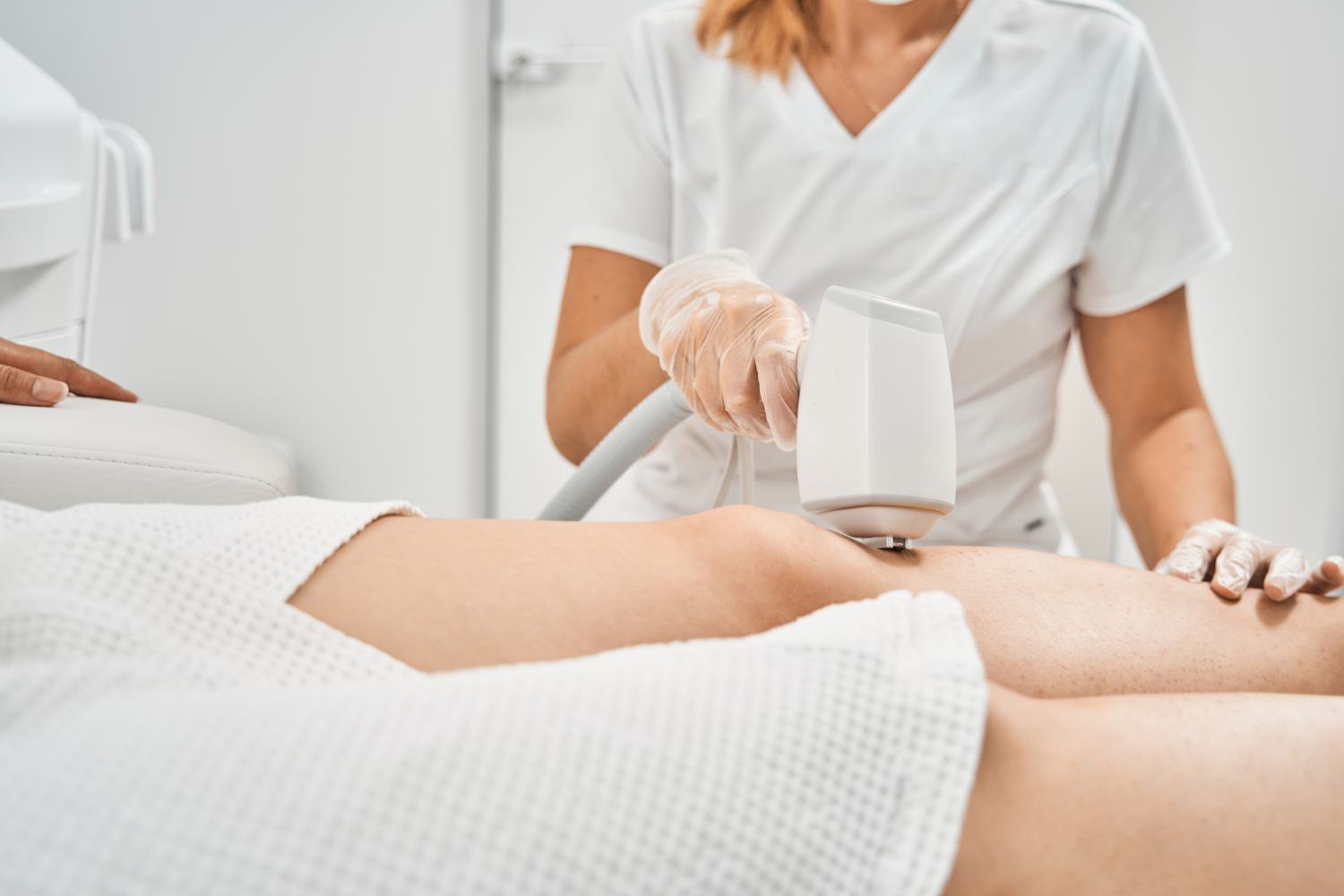
Izmir ND:YAG Laser Hair Removal
What is ND:YAG Laser Hair Removal?
ND:YAG (Neodymium-doped Yttrium Aluminum Garnet) is the name of the crystal used to produce laser light, and this system produces light energy at a wavelength of 1064 nm. This wavelength is one of the longest wavelengths used in aesthetic dermatology. The basic principle in laser hair removal is that light energy is absorbed by the melanin pigment in the hair follicle, converted into heat, and destroys the root.
The most significant feature of the ND:YAG laser is its lower sensitivity to melanin (pigment) compared to other laser types (Alexandrite or Diode). While this feature may seem like a disadvantage at first glance, it is actually the system’s greatest strength. Its low melanin retention allows the laser light to “ignore” the dense pigment in the upper layer of the skin (epidermis) and reach the deeper hair follicle without damaging the skin. This ensures safe hair removal, minimizing the risk of burns even on very dark skin.
How Does ND:YAG Laser Technology Work?
The 1064 nm wavelength is close to the infrared range in the electromagnetic spectrum. When this light is applied to the skin, the following mechanisms are activated:
- Deep Penetration: The light can penetrate up to 4-5 mm deep into the skin. This allows it to reach deep-seated hair follicles (for example, deep roots on the back or bikini area) that other lasers have difficulty reaching.
- Vascular Targeting: The ND:YAG laser targets not only the hair pigment but also the capillaries (papillae) that nourish the hair follicle. The energy absorbed by hemoglobin coagulates (constricts) the blood vessel that nourishes the hair follicle. The hair follicle, deprived of nourishment, weakens and eventually dies.
- Epidermal Protection: Because it does not target melanin on the skin’s surface, it delivers energy directly to the target without creating a risk of skin burns in dark and tanned skin tones.
Differences Between ND:YAG Laser and Other Laser Types
The fundamental difference between laser systems is wavelength. This difference alters the application area and target audience.
| Feature | Alexandrite Laser (755 nm) | Diode Laser (810 nm) | ND:YAG Laser (1064 nm) |
|---|---|---|---|
| Wavelength | 755 nm (Short) | 810 nm (Medium) | 1064 nm (Long) |
| Melanin Absorption | Very High | High | Low |
| Penetration Depth | Surface – Medium | Medium – Deep | Deepest |
| Ideal Skin Type | Fair Skin (Type I-III) | All Skin Types (Type I-V) | Dark and Bronzed Skin (Type IV-VI) |
| Target | Hair Pigment Only | Pigment and Root | Root, Vessel and Deep Structures |
Which Skin Types Are Suitable for ND:YAG Laser?
Fitzpatrick skin According to the skin type scale, people are classified from 1 to 6 based on their skin color and reaction to the sun.
Type I-III (Light Skin): Alexandrite laser is more effective in this group.
Type IV (Dark/Brown Skin): Common in Turkish population. ND:YAG is used safely.
Type V-VI (Very Dark Skin/Afro-American): The melanin density in the skin is very high. While other lasers can burn the skin, the ND:YAG laser is the only safest and FDA-approved option in the world for these skin types.
Advantage of Penetrating Under the Skin and Mechanism of Action
In some body areas (back, shoulders, under the chin), hair follicles are anatomically located deeper. Lasers that act superficially cannot deliver sufficient energy to these follicles, and even if the hairs become thinner, they are not completely eliminated. The ND:YAG laser’s 1064 nm wavelength passes through a gap called the “optical window,” reaching even the deepest roots. This feature significantly increases the success rate, especially in areas with thick skin and deep roots, such as the male back.It increases in this way.
ND:YAG Laser Hair Removal Application Process
At Izmir Private Demiderm Polyclinic, the process is carried out within the framework of medical safety protocols:
1. Consultation and Analysis: Skin type (Fitzpatrick score), hair thickness and density are evaluated. Whether there is a hormonal problem is investigated.
2. Preparation: Hair is requested to be trimmed with a razor 1-2 days before the procedure. Removal from the root (waxing, etc.) should not be done.
3. Gel Use: ND:YAG laser is generally applied with air-cooled systems without contact with the skin; however, ultrasonic gel can be used with some heads. This increases light transmission and cools the skin.
4. Test Shot: A test shot is performed on a small area to see the skin’s reaction.
5. Application: Serial shots are performed with wide spot heads. The device’s powerful cooling system protects the epidermis.
ND:YAG Laser Effectiveness Rate According to Hair Type
ND:YAG laser is very effective on thick and deeply rooted hairs (terminal hairs). Its effect may be limited in fine hairs (vellus) due to the low melanin content. However, it is unrivaled in the treatment of “Ingrown Hairs” (Pseudofolliculitis Barba). Especially in men experiencing ingrown hairs in the neck area, the ND:YAG laser both destroys the hair and heals the skin by drying out the infection.
Safety of ND:YAG Laser in Dark-Skinned Individuals
In dark-skinned individuals, the epidermis layer is heavily protected by melanocytes. Lasers like Alexandrite can target this melanin, causing “hypopigmentation” (white spots) or burns on the skin. The ND:YAG laser, however, “bypasses” (skips) the melanin in the epidermis. The energy is absorbed in the dermis layer, not on the skin surface. This allows for treatment with high energies on dark-skinned individuals without the risk of discoloration or burns.
ND:YAG Laser Session Intervals and Treatment Planning
The hair cycle (Anagen, Catagen, Telogen) determines the success of the laser. Only hairs in the growth phase (Anagen) are affected by the laser.
Face Area: Hairs grow quickly, sessions are performed 4-5 weeks apart.
Body Area: Sessions are scheduled 6-8 weeks apart.
As the treatment progresses, the intervals between sessions are increased. Attending sessions regularly is critical to avoid losing the targeted hair cycle.
ND:YAG Laser Post-Treatment Recovery and Skin Reactions
Immediately after the procedure, it is normal to see small bumps and redness (erythema) in the hair follicles, called “perifollicular edema,” and this is a sign that the treatment is effective. This condition resolves spontaneously within 1-2 hours, at most within 24 hours. Rarely, itching may occur. Due to the deep penetration of the ND:YAG laser, a slight warming sensation may persist on the skin after the procedure.
How Many Sessions Are Needed for Permanent Results?
To say “it’s over,” the goal is usually to reduce total hair density by 80-90%. The average number of sessions for ND:YAG laser treatment is:
Body: 6-10 Sessions.
Face: 10-12 Sessions (May vary depending on hormonal structure).
In individuals with darker skin, the number of sessions may be 1-2 sessions higher as the dosage is gradually increased to protect the skin.
The Effect of ND:YAG Laser on Fine and Thick Hairs
Thick hairs respond more quickly because they transmit laser energy better. Fine hairs, on the other hand, have less melanin. The ND:YAG laser targets the structure that nourishes the hair follicle via the blood vessels, allowing for results even on fine hairs (although slower than other lasers). However, no laser is effective on graying hair.
Which Areas Can Be Treated with ND:YAG Laser?
It can be safely applied to the entire body except the eye socket:
– Face (Upper lip, chin, sideburns).
– Neck and nape (Ideal for ingrown hairs).
– Underarms and Genital Area (ND:YAG is very safe because it is dark in color).
– Legs, Arms, Back, and Chest.
Sun Protection Recommendations After ND:YAG Laser Treatment
Although it can be applied to tanned skin, the skin is sensitive to UV rays after laser treatment. Direct sun exposure should be avoided for 1 week after the procedure, and a high factor (SPF 50+) sunscreen should be applied to exposed areas. This is a standard procedure to prevent the formation of spots.
Pain Level: Does ND:YAG Laser Hurt?
To be honest, ND:YAG laser is slightly more noticeable than other systems. This is because the energy penetrates deeper (closer to nerve endings). Patients often describe a “deep bite” or “rubber bump” sensation. However, powerful air cooling systems in modern devices (blowing down to -20 degrees) numb the skin, reducing this sensation to a tolerable level.
ND:YAG Laser Side Effects and Safety Information
When performed by expert hands, it is extremely safe. Possible side effects are temporary: redness, swelling, and tenderness. Rarely, crusting or pigment changes may occur if performed with incorrect dosage or by unqualified individuals. At Izmir Private Demiderm Polyclinic, all procedures are performed under the supervision of a physician and by certified specialists.
Comparison of ND:YAG Laser Hair Removal with Alexandrite
Alexandrite lasers are comfortable and fast, giving excellent results on light skin, but cannot be used in summer and are risky on dark skin. ND:YAG lasers, on the other hand, can be used year-round, are safe even on the darkest skin tones, and target deep roots. Ideally, both devices should be available in the clinic, and the patient should be able to switch between them according to their needs (or the season) (Combined Treatment).
The Performance of ND:YAG Laser on Tanned Skin
A person who gets a tan during a summer vacation faces the risk of burns if they have Alexandrite laser treatment. However, they can continue their treatment without interruption with an ND:YAG laser. Tanning is an increase in melanin in the epidermis layer. Since ND:YAG bypasses this layer, tanned skin does not prevent the laser from reaching its target.
Why ND:YAG in a Clinical Setting, Not in Hair Salons/Aesthetic Salons?
ND:YAG lasers are powerful medical devices that produce high energy (Class 4 Lasers). The use of these devices is legally only possible in healthcare facilities such as polyclinics, medical centers, or hospitals, under the supervision of a physician. Devices used in beauty salons are generally low-energy IPL (Light) systems and are not true lasers. For your health and skin, a medical environment should be preferred.
Things to Avoid After ND:YAG Laser Hair Removal
-
- Do not shower with hot water or scrub the area for the first 24 hours.
- Stay away from places with a risk of infection such as Turkish baths, saunas, and swimming pools for the first 2-3 days.
- Do not wear tight clothing that will irritate the area.
- Avoid sun exposure.
- Do not remove hairs that grow back after the procedure with tweezers or waxing;
It should be expected that the hairs will fall out spontaneously.
When Will ND:YAG Laser Results Be Seen?
Within 10-15 days after the procedure, the hairs whose roots have been destroyed will begin to fall out spontaneously. This process is called the “shedding phase”. Exfoliation can help with this process. It is noticeable that the hairs become thinner and sparser from the first session. Completion of the course is necessary for permanent results.
ND:YAG Laser Applications Specifically for Men
Men’s hair follicles are deeper and thicker than women’s. Especially the back, shoulders, nape, and upper cheeks are the most difficult areas for laser hair removal. Thanks to its deep penetration feature, the ND:YAG laser is the technology with the highest success rate in male hair removal. It also provides a dual benefit for men with its ability to treat ingrown hairs and inflammations (folliculitis) that occur after shaving.
Things to Know Before Getting ND:YAG Laser Hair Removal
Laser hair removal is a process that requires patience. If you have a hormonal disorder (polycystic ovary syndrome, etc.), laser alone may not be sufficient and should be supported by medical treatment. Furthermore, the brand of the device used, its maintenance, and the experience of the practitioner directly affect the quality of the result. Choosing “scientific” and “reliable” centers instead of “cheap” and “guaranteed” promises is the best investment for your health.