
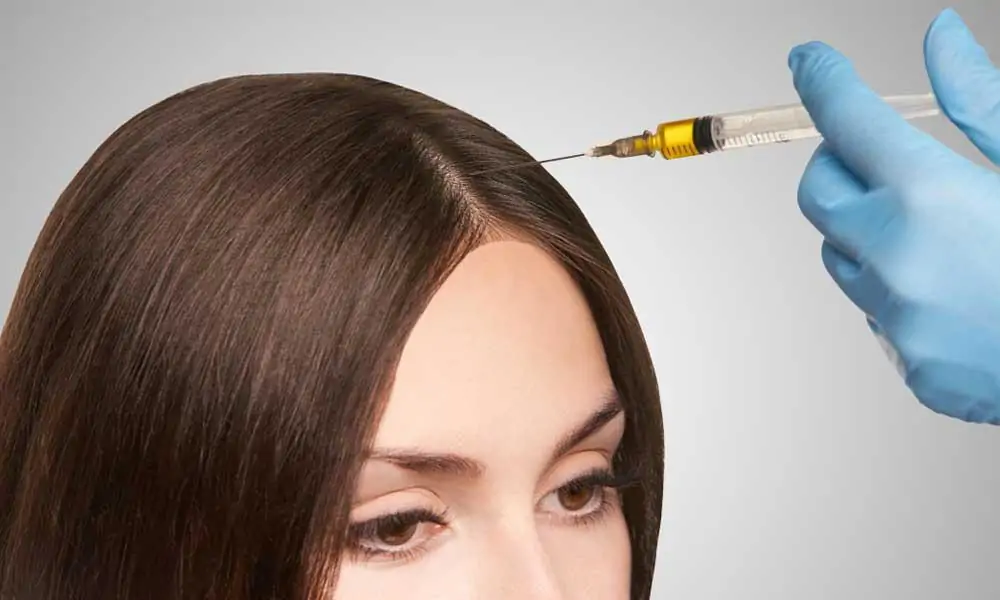
Izmir PRP Hair Treatment
What is PRP Hair Treatment?
PRP (Platelet Rich Plasma) is a procedure in which plasma fluid enriched with platelet cells, obtained from the person’s own blood (autologous), is injected into the area to be treated. Used in many areas of medicine (orthopedics, dentistry, wound healing) to accelerate tissue healing, this method has become one of the “gold standard” treatments in dermatology, especially in hair loss and skin rejuvenation.
While our normal blood circulation contains an average of 200,000 platelets per milliliter, this number is increased to 1,000,000 and above in the plasma obtained through the PRP procedure. This high concentration, when applied to the scalp, allows the body to initiate an “emergency repair” process in that area.
How is PRP Prepared?
Natural Treatment with Your Own Blood
The PRP preparation process is a chain requiring laboratory precision. The protocol applied at Izmir Private Demiderm Polyclinic is as follows:
- Blood Collection: Approximately 10-20 cc of blood is taken from the patient’s arm vein, as in a standard blood test. This blood is transferred to sterile tubes containing special anticoagulant substances.
- Centrifugation Process: The tubes are placed in a special centrifuge device. The device rotates at a certain speed and time, separating the blood into its components. In this process, red blood cells (erythrocytes) settle to the bottom, while platelets and plasma remain at the top.
- Separation: The “Buffy Coat” layer, where platelets are most concentrated, and the plasma are separated from the red cells using a special pipetting method. The resulting yellow liquid is “Platelet-Rich Plasma”.
- Activation (If Necessary): In some cases, activators such as calcium chloride may be added to release growth factors from platelets more quickly.
How Does PRP Affect Hair? Mechanism and Scientific Basis
The “magic” of PRP lies in the Growth Factors hidden within the platelets. When injected, platelets break down and release the following factors:
- PDGF (Platelet Derived Growth Factor): Supports cell growth and blood vessel formation.
- VEGF (Vascular Endothelial Growth Factor): Increases blood flow and nourishment to hair follicles by promoting new capillary formation.
- TGF-Beta (Transforming Growth Factor): Strengthens the intercellular matrix.
- EGF (Epidermal Growth Factor): Promotes skin cell renewal.
When these factors combine, they stimulate hair follicles in the dormant phase (Telogen) to enter the growth phase (Anagen), expand the vascular network that nourishes the hair follicles, and thicken the diameter of the hair strand.
Who is PRP Hair Treatment Suitable For?
PRP treatment gives the best results in people whose hair follicles are not yet dead but have weakened (miniaturized). Ideal candidates:
- Men and women with early or moderate stages of genetic hair loss (Androgenetic Alopecia).
- Those experiencing general thinning, dullness, and loss of volume in their hair.
- Those experiencing severe hair loss due to seasonal changes or stress.
- Those who have undergone hair transplantation and want to improve the success of the result.
- Those undergoing treatment for Alopecia Areata (under physician supervision).
- Mothers experiencing postpartum hair loss (with doctor’s approval during breastfeeding).
How Does PRP Treatment Reduce Hair Loss?
One of the main causes of hair loss is the insufficient nourishment of the hair follicle and its subsequent “root atrophy” (shrinkage of the root). PRP increases microcirculation in the scalp, allowing the roots to receive more oxygen and nutrients. It also regulates the hair’s life cycle, preventing hair loss.It delays the hair loss cycle. With regular sessions, hair loss is reduced to physiological limits (50-100 strands per day).
PRP Application Process and Stages
At İzmir Private Demiderm Polyclinic, patient comfort is prioritized:
1. Preparation: The scalp to be treated is cleaned with an antiseptic solution. For patients with a low pain threshold, topical anesthetic sprays or cooling caps can be used.
2. Injection: The prepared PRP solution is injected into the depth where the hair follicles are located (dermis layer) using very fine needles (30G) with the “Napaj” technique or micro-papule technique.
3. Massage: At the end of the procedure, a light massage is performed to ensure homogeneous distribution of the plasma.
How Many Sessions of PRP Hair Treatment Are Needed?
PRP is a treatment that shows a cumulative effect. It is not realistic to expect miracles in a single session.
Initial Treatment: A course of 4 to 6 sessions, usually applied every 2-3 weeks, is recommended.
Maintenance (Protection) Treatment: After the completion of the treatment, it is recommended to perform single-session booster doses every 3-6 months to maintain the results. This interval may be shorter for those with aggressive genetic hair loss.
When Does Hair Thickening Begin with PRP?
While the biological response to the treatment varies from person to person, generally:
2-3rd Session: A significant reduction in hair loss is observed.
4th Session and Beyond: An increase in hair quality, shine, and volume is observed. Miniaturized hairs are seen to thicken and transform into terminal hairs. The full effect continues in the months following the completion of the treatment.
Things to Consider Before PRP Treatment
- Alcohol consumption should be stopped at least 3 days before the procedure.
- Blood-thinning medications (with doctor’s approval) should be discontinued before the procedure.
- Hair should be washed on the day of the procedure; styling products such as gel and spray should not be used.
- Heavy, greasy meals should be avoided before the procedure, but one should not come on an empty stomach.
Recovery and Care Process After PRP
PRP is a procedure that “does not affect social life”.
First 24 Hours: Hair should not be washed.
Sun Protection: Direct sunlight should be avoided on the day of the procedure.
Activity: Sweating activities such as Turkish baths, saunas, and strenuous sports should be avoided on the day of the procedure.
Bathing: You can bathe the next day with lukewarm water and a mild shampoo.
Effectiveness of PRP in Genetic Hair Loss
Androgenetic alopecia (genetic hair loss) is the process where the DHT hormone attacks and weakens hair follicles. PRP cannot change this genetic coding, but it significantly slows down this process by increasing the resistance of the hair follicle. Especially in people who start hair loss at an early age (20s), PRP is the most effective weapon to postpone the baldness process and delay the age for hair transplantation.
PRP Hair Treatment Approach in Women and Men
In Men: It is critical to apply it before the roots completely die, especially in areas with thinning at the temples and crown.
In Women: Since “diffuse” (widespread) hair loss is usually observed, the entire scalp is treated. In women, PRP has a very high success rate in increasing hair volume and stopping hair thinning.
PRP – Mesotherapy Comparison: Which is More Effective?
These two treatments are not competitors, but complementary.
| Features | PRP (Platelet-Rich Plasma) | Hair Mesotherapy |
|---|---|---|
| Contents | Growth factors obtained from your own blood. | Externally prepared vitamin, mineral, and drug cocktail. |
| Source | Autologous (Natural). | Synthetic/Herbal Mixture. |
| Mechanism of Action | Cell renewal and repair. | Nutrition and deficiencies removal. |
| Application | Once a month or once every 3 weeks. | Once a week or once every 2 weeks. |
| Combination | Can be done alternately with mesotherapy. | Can be done alternately with PRP. |
Use of PRP as a Supportive Treatment After Hair Transplantation
PRP is vital for patients who have undergone hair transplantation surgery.
For the Donor Area: It ensures rapid healing of the donor area from which the hair is taken.
For the Transplantation Area: It increases the viability of newly transplanted roots (grafts), alleviates the shock shedding process, and allows new hair to grow faster and thicker. PRP is applied as a standard part of our hair transplantation protocols at Izmir Private Demiderm Polyclinic.
PRP Application in Seasonal Hair Loss
For increased hair loss in autumn and spring, PRP acts as a protective shield. 1-2 PRP treatments performed just before seasonal changes (e.g., in September or March)A single PRP session strengthens hair follicles, ensuring a hairless recovery from this period.
The Effect of PRP on Hormonal Hair Loss
Thyroid problems, PCOS (Polycystic Ovary Syndrome), or hormonal fluctuations during menopause impair hair quality. While the underlying hormonal problem is treated medically, PRP, applied simultaneously, helps hair follicles gain resistance to this hormonal stress.
Pain and Sensitivity During PRP Treatment
Because the PRP procedure is performed with micro-needles, patients generally describe it as a “mild mosquito bite” or “tingling.” There is no unbearable pain. However, since the pain threshold varies from person to person, cooling or anesthetic applications before the procedure make the process completely comfortable.
Is PRP Treatment Safe? Possible Side Effects
Because PRP is obtained entirely from the person’s own blood, it is the “most natural” and “safest” medical aesthetic application. The risk of allergy or tissue rejection is zero. Possible side effects are only temporary redness or minor bruising at the injection site, which disappear within 1-2 days.
PRP’s Contribution to Scalp Regeneration
Healthy hair comes from a healthy scalp. PRP treats not only the root but also the scalp. It regulates the skin’s moisture balance, thickens the skin by increasing collagen production, and helps balance dandruff/oily skin problems. It provides great relief, especially for patients with dry and itchy scalps.
Who Should Not Get PRP Hair Treatment?
- Those with very low platelet count (Thrombocytopenia).
- Those undergoing active cancer treatment.
- Those with active infection in the application area.
- Patients who cannot stop blood thinner treatment.
- Those with chronic liver disease.
How is a PRP Treatment Program Planned?
The treatment plan is not a standard package, but a personalized prescription. After your doctor performs a hair analysis, they will determine how many sessions are needed, the intervals between sessions, and, if necessary, combination with other treatments (mesotherapy, medication) according to the stage of hair loss. The goal is to achieve maximum benefit in the shortest possible time.
Things to Know Before Getting PRP Hair Treatment
PRP cannot revive dead hair follicles (completely bald areas where pores are closed). Hair transplantation is the only solution for these areas. However, PRP is an excellent “revival” treatment for existing, thinning, and weakened hair. Furthermore, the quality of the PRP kit used is crucial; procedures performed with ordinary laboratory tubes are not PRP. Our clinic uses certified kits specifically manufactured for hair treatment, providing high concentrations.
The content on this page is for informational purposes only. It does not constitute diagnosis or treatment. PRP treatment and hair loss solutions are medical procedures that require individual planning.